
Luise’s Autobiography
|1| My father was the renowned Sir Johann David Michaelis, scholar of the ancient Near East, and my mother Louise Antoinette Schröder, daughter of Senior Postmaster Schröder in Göttingen, [I was?] born of respected parents — and reared in a prosperous middle-class home where there was no lack and yet strict order, and surrounded by the most distinguished persons (frontispiece to Geschichte der Miß Fanny Wilkes, trans. from the English, vol. 2 [Leipzig 1770]):

My earliest memories extend back to my second year [1772], where I can still clearly remember being held in someone’s arms at the viewing of the corpse of an elderly great aunt, the sister of my father’s mother and Dr. Christiani’s widow. My father had brought her back with him from Halle after attending to his father’s estate, while she in her turn had taken care of my grandfather’s household after the death of his wife, née Heldberg, from Celle. My father asked his childless brother in Celle for permission to carry on the family coat-of-arms, since with him the family would die out.
According to the custom of the time, the body was put on view in the house’s entrance hall surrounded by geridons with wax candles and with a lemon in her folded hands. [1] This entire scene made a lasting impression on me, albeit a rather chilling one, since but a few days [before?] I myself had yet seen this elderly aunt, whom everyone respected.
Although I later forgot many of the things that happened up till I was 6 years old, some things have nonetheless resurfaced in my memory, though nothing important enough to be written down, albeit probably interesting enough to be related to a bunch of granddaughters and young girls to give them some idea of how things were during the good old days, that they might be astonished at the simplicity characterizing things in daily life and at how the day was usually organized etc. But all this would take me too far astray, and I would only end up prattling on forever.
|2| I can still remember it being extremely hard for me to learn to read, costing me many a tear and our house tutor, candidate Borchers, many an unpleasant hour; so [I] also discussed it with my 16-year-old sister, Caroline, and in the end I did learn, though I probably also read a great deal that was absolutely useless. [1a]
This particular tutor later became pastor in Diemern [Diemarden], not far from the handsome office Rheinhausen [Reinhausen]. The village was so close to Göttingen that it could be reached on foot, and my sister Lotte and I made this trek often during the years 1784 to 1789, spending many a happy hour there, and certainly also two weeks there each summer.
(Carte der Gegend um Göttingen auf 2. und 3. Meilen, ed. H. F. Irsengarth:)

The parsonage was located next to the village’s very handsome assembly place, which one usually refers to as the tinc, a name apparently deriving from the Nordic designation where in earlier times the ancients held court. The large space was elevated several steps high, with a stone enclosure one or two feet high, and planted with the most beautiful linden trees. There was a brook with a walkway over it, and willows along the brook; behind it the village limited the view just as on the opposite side the church and magistrate’s building situated a bit higher.
(Diemarden and Brook Garde; undated postcard:)

Here we would gather for coffee with the wife, husband, and the little children with their maidservant, and fantasized when we were alone — each in his own way. Naturally, we did not forget books, nor that the wife’s clothes were done up a bit in the current fashion for a possible visit to our house. At the time clothing was much less uniform, or equal, the classes were more clearly distinguished, and not, as is today the case, merely by the types of fabric; the proverb or turn of phrase was still true: “The word of God comes from the country.” [2] Today a pastor’s wife appears in public dressed as elegantly as the wife of an Etatsrrath [3] or [?] the normal citizen’s daughter.
We always arranged our time such that we could accompany Pastor Borchers on Sunday to the beautiful filial Rheinhausen [Reinhausen], a pleasant route, the church and magistrate’s building, a former monastery, being situated on a cliff.
(Carte der Gegend um Göttingen auf 2. und 3. Meilen, ed. H. F. Irsengarth:)

The village through which the main thoroughfare passed was located below and opposite, with the most beautiful forests covering the hills; indeed, there could hardly be a more beautiful place. —
We were friends with the bailiff’s daughters, |3| and I remember how once, when I was about 10 years old, we paid a visit there with our friends the Böhmers, and how everyone was so content as soon as [so much so that?] the long corridors and cloisters leading around the monastery building prompted the young girls to terrify one another with all sorts of ghost stories. —
(Reinhausen monastery; undated postcard:)

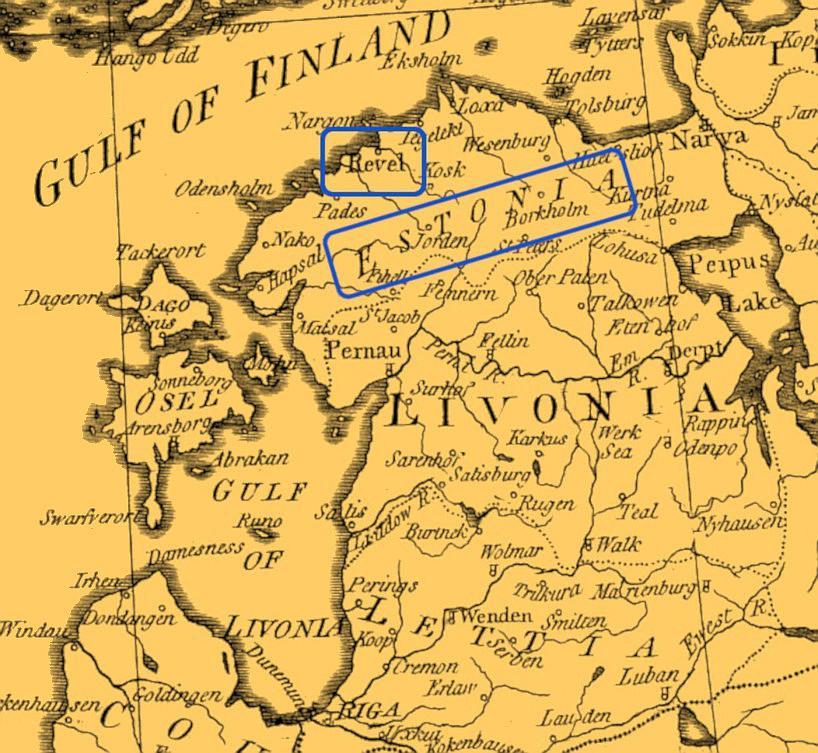
We stayed here with the pastor till the evening, and our friendship was renewed — though not for life, for the girl closest to me in age was married off to someone in Reval [Tallinn, Estonia] and the eldest also removed from a circle of friendship through marriage.
(Thomas Kitchin, A new map of the Northern States containing the Kingdoms of Sweden, Denmark, and Norway [London 1790]:)
From Diemern [Diemarden], Lotte and I also took an excursion to the von Uslars, who lived next to the same old castle[s?]; Dieterich picked us up, who was also Lotte’s secret fiancë at the time. Beautiful Mademoiselle Uslar had been unhappily married at 14 [years of age] to one of Dieterich’s acquaintances. They later divorced, and she died! I never saw a more beautiful young girl than Countess Hardenberg.
Having my mother tell us stories about the Seven Years War [1756–63] was one of the most pleasant forms of entertainment one can imagine, more so even than Robinson, which we devoured at the time along with the Kinderfreund whenever issues appeared at the book fair. [4] Even lately I have still enjoyed leafing through the latter and remembering my happy childhood. —
My mother could not repeat often enough many of the stories she told us. She had an extremely delicate handwriting, and often when French couriers came [during the war], she had to get out of bed to write down numbers or other small reports for her father, a zealous patriot; these reports were dipped in wax, and the loyal postillion then had to put them in his mouth that he might pass them along to those in Hannover, who would thereby receive news about their relatives. Our grandfather, a loyal man who loved his fatherland, failed to consider that any betrayal would have caused him enormous trouble.
Our mother also told us about the small skirmishes one could see from the house’s attic [5] along the forest above the village of Wende [Weende, just north of Göttingen], and about how she was especially frightened by the appearance of a white horse that a countryman and friend of their youth was riding, and what they were able to see sometimes here, sometimes there — and how she always feared the horse would stumble and the rider be shot.
|4| Or she told us how during the French retreat a powder tower was detonated, and how the arms and legs of the mutilated soldiers were slung far out into the gardens. She also remembered the time when they were already married and received a sauvegarde letter — which is also mentioned in my father’s biography as an honorific distinction, though up till the French vacated Göttingen my father did have a high-ranking, extremely charming colonel in his house, who was also an excellent and refined man. [6]
She also recalled the Lisbon earthquake [1 November 1755] — and my grandmother told us stories about earlier times and let us play at her place, and let the elder Böhmer girls and my sister [Caroline] cook [see letter 34], teaching them thus through play — she was a well-educated woman for her time who also took care of the postal business and all the large leases until her eldest son took over the position; she died of a stroke when I was 10 or 11 years old. She lived with her youngest son. She died on her birthday, New Year’s Day [1781]. She had lain down on a chaise longue and was reading in the Bible when death came to her. Even today her image is still a very pleasant one for me, in her delicately folded bonnet.
In Wilhelmine Walch, daughter of the famous theologian and friend of my father, I found a dear friend and playmate in whose house I was always well received whenever I had free time. The children of Hofrath Feder also used to gather in her house, and especially my dear friend Dorothea Schlözer. The house was characterized by a simple, patriarchal atmosphere as in the olden days.
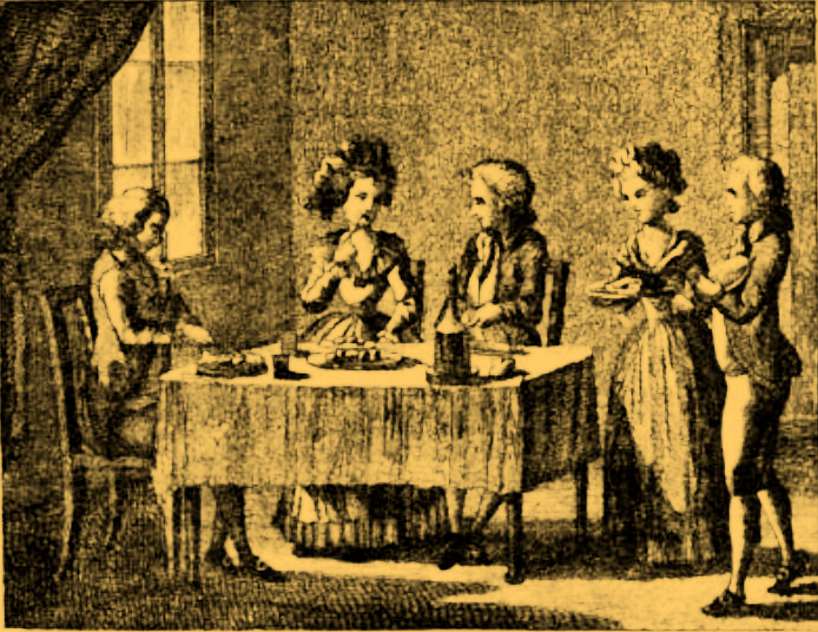
What especially attracted us children was the wonderful reception we received, the coffee they served each afternoon at 3:00, something we never got at home, the garden, and the general lifestyle of these elderly people, the father always coming home for coffee —
(Carlo Goldoni, Opere complete, vol. 9 [Venice 1910], 413:)
Although we never abused these freedoms, we did spend many a winter evening there. The only son became a professor in Heidelberg. The daughter, after her father and mother had died, died herself after a long period of sickliness during which we no longer saw each other as often.
What often made me so sorry was that the relationships and social contact were not the same, which should not have been the case. Other distractions should not have pushed aside the sickly former playmate. One feels this oneself in later years, when one is neglected by others and feels lonely and abandoned.
|5| In 1776 I was inoculated with smallpox, though at the time this was done completely wrong and only made the illness even more frightening. Beforehand the person was given a meal of simple food, but then was packed into a bed well covered with feather duvets, and had to drink elderberry tea. I was a strong, well nourished child, and yet this treatment resulted in the pustules emerging quite horribly, my hands and feet and especially my head then being covered in pox. My eldest brother from my father’s first marriage, Oberhofrath Michaelis, had just returned home from Strasbourg as a physician, and also attended me.
At that time, a certain Herr von Ramdohr from Celle, who was friends with my brother and later wrote about painting, came to visit quite often. I still remember him as an excellent person, not externally but with refined manners and behavior. He visited us later as well, and my initial childhood impressions remained, though those impressions also had a more painful side. I was attending a knitting school at the time, and a very pretty maidservant, who was reared in our house as one of my eldest brother’s playmates, would come pick me up; we were then always accompanied by Herr von Ramdohr, whom I eagerly awaited because of sugar cookies, and although as a child I certainly enjoyed this nice gesture, I never realized that my young companion was the magnet drawing the young man out of the monastery building of what is today the library. [7]
But it completely shattered my modest vanity when after having smallpox I took the same route, and our noble companion joined us as usual but then said to the maidservant, “Look how ugly the pretty child has become!” This remark made an enormous impression on me and likely kept me from falling prey to the various temptations to be vain, that is, to believe that I was pretty. I never forgot this experience, and the mirror also instructed me in this regard. But one is happy to forget such things when such becomes possible through various other distinctions.
After my brother’s return, life changed in our family, since my eldest sister [Caroline] was already grown and Lotte was now also getting older as well. [8] Since my father had hitherto never permitted them to attend public assemblies and balls, |6| and did not do so at that time either, my brother arranged that winter for several families [to participate in such balls], such as especially Schlözer’s wife and her sister as well as the Meisters [9] and especially the Böhmer family, which was so numerous that we all had our own, specific friends in it.
For example, my eldest brother was friends with the 3 eldest sons, of whom even at that time the second was already an admirer of Caroline — and whom she would also later marry as a faithful suitor whom she did not reject [unclear; “who did not withdraw his attentions?”], which subsequently often depressed us. And so also with my sister Lotte, whose fate would have taken a different turn had she married the third brother, the later senior appeals councilor in Celle. Both he and she would, one might hope, have been happier.
And there were similarly also daughters [in the Böhmer family] for each of us, Emmi being especially friends with Caroline and Lotte, she then marrying Cathedral Canon Meyer in Hamburg, a relationship that did not, however, develop until later, during 1780 to 1782, when he was studying in Göttingen. — Louise was later Lotte’s girlfriend, and I had contact and daily dealings with her at the time as well as with Philippine, since our gardens were adjacent. [10]
But let me return to how this assembly and dance came about to which my brother invited the most distinguished young people. [11] Relatives and other residents of Göttingen were also invited.
The piqueniks, as they were called, where the gentlemen paid for the music and my father provided for the public house and tea, concluded with a grand ball, which my father gave for the young people as well as his own friends on his birthday and whence the two poems come in the supplement, by a lady friend of my father and mother, Dorothea Ayrer, wife of the well-known equerry, who was also a friend of my father after he married, indeed often playing the role of peacemaker between the marriage partners just as had earlier been the matchmaker. [12] Dorothea Schlözer, who later became famous, also attended the birthday ball as a child, as did I myself, and I can remember how we jumped around, hair all done up, in our whalebone skirts and green damask leading-string smocks — certainly droll enough!
I may well be mixing up some dates here, but I do remember that after this period my brother went to London to continue his education, and I believe also my subsequent brother-in-law |7| Böhmer, since when he returned I remember him coming over often during the evenings specifically to give my sister Caroline instruction in English.
The wife of Justizrath Böhmer had close relatives in London, her father himself had worked in the German chancery and her sister was married to Herr Best, who had some title I can no longer remember, who had 3 daughters, each of whom, one after the other, married German pastors in London and thus afterward were transferred to Hannover. [13] In 1781 my brother-in-law went and fetched the elderly Best to come visit them. At the time, the channel crossing was not as easy.
I have written in my sections on Caroline and Lotte about various other things that took place during this time. Soon after Böhmer returned with the elderly Best, he received an appointment as mining physician in Clausthal, and my sister’s wedding took place in 1882 [!] [15 June 1784], and that autumn I myself traveled to Gotha with the family of Professor Koppe, who was moving to Gotha as superintendent.
(Post Karte Durch ganz Deutschland, ed. J. Walch [Augsburg 1795]):

I was not to receive my education in Göttingen itself between the age of 14 and 14 [16!], nor go out into the world too early. Like my sisters, I was to attend the school of Frau Schläger, wife of the privy Hofrath and famous librarian in Gotha, the latter of whom then died while I was in Gotha.
This stay was very enjoyable and useful for me. There was an extremely cultured lady there, distinguished at court, around whom a group invariably gathered in the Tea Society whenever she passed out her calling cards and came to visit among the young people and gather for tea. [14] That Tea Society was well known in Gotha and had developed into quite an institution also for non-residents and resident young people, who could be introduced to society there.
It was there that I myself got to know the young Friedrich Jacobs and his brother as well as the famous Schlichtegroll, even dancing with them at the balls and conversing with them at Frau Schläger’s, where so many distinguished people visited, including the subsequently famous Wiebeking, who has also since died. Indeed, I can now point to one acquaintance after the other with a †.
Wiebeking as well as Schlichtegroll both married granddaughters of Frau Schläger. Both were daughters of a former tutor of the duke, a certain Rousseau. Another elderly man from Geneva [or: old Genevan?] similarly visited, Herr Galatin, [15] and conversations were generally carried on in French and included other distinguished young ladies as well, whom Frau Schläger always received with distinction |8| and greeted like a universally revered elderly lady. She was also a learned woman, though she taught more through conversation than through instruction in the usual sense.
I kept up an ongoing correspondence with Dorothea Schlözer and regret having given one particular, very noteworthy letter to her uncle, General Consul [Karl] von Schlözer in Lübeck, that it might be preserved for the world. In that letter, I asked her whether it was quite in accordance with her inclinations that she was being educated as a scholar. She remarked that it was not all that bad, and expressed herself concerning so many things that I was ashamed to show anyone the letter and always carried it with me; nonetheless it was not entirely torn up, and I can still vividly remember everything in it, and would like to try to relate some of its content, though such is not really possible to do in the manner that was so unique to Dorothea herself. She was, however, basically satisfied with what her father was demanding of her and in fact derived quite a bit of additional enjoyment from it all, such as the various journeys.
She and her father also visited me once in Gotha, as did my brother, who after returning from America in 1782 [1784] for my sister’s wedding [15 June 1784] — where he had gone with the Hessian troops as a staff medical officer — visited me in Gotha from Kassel, where he had become court physician.
(Post Karte Durch ganz Deutschland, ed. J. Walch [Augsburg 1795]:)

He also visited especially the Gotter family. The wife, née Stieler, was Caroline’s best lady friend. It was quite entertaining getting together on Sundays with young playmates and giving extensive performances of proverbs in conversation; these friends included one dear friend of my youth who was also confirmed with me and who remained friends with me for life, Carl von Hoff † and his sister Friederike von Hoff-Reinbold †.
Let me not forget to mention the two court balls given by the two princes, August and Friedrich, who were our same age at the time. [16] The two later became famous enough, but the line died out with them. All our acquaintances were invited, and I traveled over to the court alone. The elderly duke, a patron of my father, conversed for a particularly long time with me as he was going around the table and greeting the young guests. [Marginal note: 1783 (more likely: 1785).]
Let me return for a moment to my very first instruction in religion and other subjects, and later instruction as well from my 10th to my |9| 14th year — including history and geography. Although I did not share this instruction with Dorothea Schlözer, her father having already decided that she was to educated as a scholar, I did have similarly excellent tutors along with her whom her father chose from among the students.
Alas, I never really distinguished myself in learning as did Fräulein Schlözer, though I do remember much from that period. I was never required to repeat things by writing down what I had learned during the lesson. I remember only that I had to copy material about English history out of a notebook the tutor had, and similarly also read things during religion class. I took geography from the subsequently famous Professor Gaspari, though he was a repugnant person who could have had an extremely negative effect on an older girl. I think I also took biblical history from him.
One tutor, however, by the name of Bernstein, from Gera, who had already earlier worked in our house as a tutor, was an extremely ugly but otherwise excellent, good person disfigured by smallpox; he came to us later as a private tutor again after the fire in Gera, where he and his mother had lost everything. [17] I now had instruction in religion from him, according to my father’s lecture on morality, where especially natural faith was first presented. It is indeed according to morality rather than dogmatics, is that not correct? I do not understand these things, and do not want to make any decision in my ignorance.
It had become, I am inclined to say, fashionable at the time as a kind of “unfaith,” where even one’s calm, normal faith in a God as the guide of human beings was challenged. Some young people considered it an honor to engage in scoffing, and one cannot imagine what effect that had on a young disposition, especially on me, and this fight and the struggle for faith and this doubt had a lifelong effect on my disposition.
But I certainly do not wish to accuse Herr Bernstein, since he was a devout and doubtless pious Christian. I also remember very clearly how my mother tried to prevent Hofrath Heyne’s son, who was known to be such a scoffer, from coming to our house too often, which was probably the case, since his mother died and |10| she, an extremely bright and distinguished woman, was the best friend of my mother, who then always received the 3 children — one son and two daughters — with love. That son became a physician and soon [?] went to Russia, dying in the Crimea.
The daughters: Therese, whose married names were later Forster and then Huber, by which latter name she also became known as a writer. This Therese was also a so-called free spirit, and my mother feared her influence especially on Lotte, from whom I also still have a letter about Therese Huber. [18] — Then Marianne, married name Reuss, who was very amiable but who could also be quite moody; she was later very close to me as a friend and had a positive moral influence on me. [19]
My mother’s opinion and views on faith can be seen in a note she wrote asking me not to neglect my own children’s religious instructrion. [20] And yet today she herself would be viewed as having been infected by my father, who certainly did not possess blind faith. It no doubt flattered my own conceit to receive instruction in religion according to an especially thorough notebook of my father’s lectures, and Christianity did not appear to me to be the way it should, being based solely on this particular instruction.
When Herr Bernstein left us, I then received only extremely shallow instruction in religion from Superintendent Luther, who had a school for girls and boys, from which I, however, could not profit as much as those with whom I took instruction there, whom I found to be far more advanced than myself in everything, especially in writing and memorizing.
For it was not until I received instruction from the senior court preacher Bause in Gotha did I learn the ten commandments and the articles of faith with Frau Schläger, and had I been publicly confirmed I may well have done very ill, though such was not the case insofar my status, or that of my father, made it possible for me to sit or stand and not be questioned, remaining sitting only at the actual confirmation —
(Thomas Stothard, Confirmation [1792]; Herzog August Bibliothek; Museums./Signatur FBartolozzi V 3.223:)

In the instructional classes themselves I always knew on my own how to answer well what I had learned. Carl and Friederike von Hoff also took these classes, and that made our friendship even stronger. [Carl von] Hoff visited me |11| later when I was staying in Jena, and it is very painful for me to think that this man met with such an unhappy end through his own hands. [21]
Pastor Bernstein came to Jena at the same time when he heard of my and my mother’s presence there. [Marginal note: visit to Jena 1798 (ed.note: correct: 1799).] He had the great misfortune of losing his wife and one of his children through a violent death when their carriage fell from a hillside because of runaway horses. I would very much like to have had instruction from General Superintendent Koppe, in whose family I spent a great deal of time and with whom I traveled from Göttingen to Gotha, and where at the time the later abbot in Lokum, Herr Hoppenstedt, was a tutor, with whose brother I was later good friends and whose letters I unfortunately destroyed, probably to prevent anyone from drawing false conclusions — prior to my first child’s birth.
At that time, Abbot Hoppenstedt delivered his first sermon in Gotha, in the orphanage chapel. All his patronesses and lady friends were present; unfortunately the young, lively candidate quite failed, having gotten completely and utterly bogged down. He fled home and immediately declared to Superintendent Koppe that he would never, ever again climb into the pulpit, to which the latter, however, immediately responded, “On the contrary, you will climb into that very same pulpit again next Sunday.” And he did just that, delivering a quite beautiful sermon, later becoming an equally excellent and popular preacher. When I later heard him preach in Harburg, I recalled that shipwrecked initial sermon.
After I was confirmed and introduced to society, and had seen all sorts of people coming and going at Frau Schläger’s, including scholars, persons from the court, and ladies, and after I had spent many a boring hour before finally learning to understand and speak French, and also made all sorts of what were for me young [new?] acquaintances, which I renewed during later visits, — I found an older guardian especially in the wife of the bookseller Ettinger, and in the [later] wife of the duke’s librarian, Amalie Seidler, married name Reichard, from Weimar, whom Friedrich Jacobs remembers with such warmth, [22] and whose younger sister, Jacobs’s own spouse, was very dear to me. I had many enjoyable and pleasant times with and at the home of Frau Ettinger, and also enjoyed the acquaintance and protection of Therese Heyne, whom I visited often when she was in Gotha caring for a lady friend, [23] she being very intimate friends |12| with Amalie; Therese was with her friend, a certain Demoiselle Schneider, up to the latter’s very end, and likely [enjoyed?] the sublime friendship of the duke at the time, Ernst [II] — a friend of the Duke of Weimar and Goethe — about which much was said, especially because Therese had allegedly tried to become even closer friends.
Be that as it may, Therese enjoyed the highest love and esteem in Gotha, otherwise my upright Frau Schläger would never have allowed me to have tea with Therese as often as I did. All sorts of visits from Göttingen greatly delighted me, such as that of Dorothea Schlözer and her father, Marianne Heyne with Professor Blumenbach and his wife, as well as my brother from Kassel.
Thanks to the Tea Society, the attendant balls in private homes, and such a cultured environment, so different from that experienced in normal boarding schools, I returned to Göttingen in my 16th year [summer 1786] quite ready to make my appearance in the world, being now no longer entirely unacquainted with it, though I did often behave rather incautiously. But my dear, respected friend, Legation Councilor Tatter, as one can see from his letters “from across the street,” [24] was a cautioning friend to me. I now wish I had always been open toward him.
During the period prior to my 14th year, Frau Bethmann-Hollweg was in Göttingen [May 1784]; her youngest daughter [Johanne Caroline Luise (1777–1801)] needed the services of the famous physician Hofrath Richter. They spent a great deal of time in our house; the eldest, Sophie, was especially a friend of my sisters and of the eldest Böhmer daughters, whereas I myself found a playmate in the youngest.
During this time as well, there was a distinguished Russian in Göttingen, Herr von Mineradovitch, along with his tutor and young cousin; [25] I still have a very pleasant memory of him, probably also because he was held in such very high esteem because of his refined manners and morality and handsomeness. He greatly resembled my sister Lotte and was also greatly attracted by her and admired her. The youngest was a wild boy, later distinguishing himself and successfully leading the Cossacks in some battle or other against the French, reports of which then filled the newspapers.
A young hereditary prince, von Nassau-Saarbrücken, along with his tutor, spent a great deal of time during this period at the homes of Böhmer and Michaelis |13| and the first families. He was engaged as a boy of 4 |13| to a certain Princess Monmorency and told stories of how she took her [him?] in her lap exclaiming quel joli garçon. But the marriage never took place [correct: 6 Oktober 1785!]; he resisted his father’s will and married beneath his status. The line died out with him.
I have many lively memories of this time. The society, our friendships with other young people, and that of the Böhmers was very pleasant for all of us, and since during this time my sister became engaged, the eldest Böhmer daughter became betrothed to Canon Meyer, my brother returned from America [May 1784], and many young people were there who were acquaintances of my brother — we all spent the winter of 1783 quite cheerfully, and every Saturday there was a so-called dancing class at our house from 8:00 till 10:00, when all these acquaintances assembled, 12 couples, and which Madam Feder and Madam Spittler also attended.
At the end of the winter, my father gave a wonderful ball on his [67th] birthday [27 February 1784]. But now he began suffering from severe gout, not recovering until the following summer shortly before my sister’s marriage to the mining physician Böhmer, so that Caroline was yet able to be a faithful nurse to him. My brother now returned to his position as court physician in Kassel, and in the autumn [1784] I myself went to Gotha, so that with Caroline now married, Lotte and Philipp remained at home alone.
The summer of 1783 was also occupied by the visit of the only daughter of my mother’s sister; her mother [i.e., Madam Michaelis’s sister], who died in childbirth, had been married to Postmaster Fischer in Lüneburg; although my mother was still mourning the death of her only sister, we were all quite happy to have this relative with us for a summer. She was an excellent girl, and though she was very quiet during the first few days, she soon became cheerful, bright, and witty. She was greatly disfigured by smallpox but had a very nice figure and shape. My sisters were quite sad when she departed. I saw her later in Lüneburg and once more afterward as well. She was married, but not happily. Her husband died, and she herself died last year at her son’s in Hamburg.
It was probably in 1785, [26] though my memory is not always reliable, that Madam Schläger brought me [to Gotha] with an unmarried daughter who had a position as chanoinesse |14| in the convent Winhausen [Wienhausen] and also with Friederike Hartmann from Hannover, both of whom were also there with their mother and aunt during my own stay in Gotha, since Fräulein Hartmann was Madam Schläger’s niece.
We constituted as it were two couples. I was under the sole supervision and discipline of the elderly lady, who genuinely did tenderly love me and care for me. I also slept at her place. The other, Friederike, was similarly under the supervision of her cousin. I was permitted to read as much French as I wanted that I might acquire [for] myself the language quickly, and received perhaps too much to read. In the evening we read serious things. We tried to get German books covertly, secretly devouring a great many books — something I am not, however, condoning. My trusty night lamp often provided the light for these undertakings, and when I had nothing, there was certainly enough material over my bed, from which I first read Weisse’s translations of Juliet and Romeo as well as the other Shakespearean pieces and his own pieces, and whatever I could understand by Sturz. Afterward I read Eschenburg’s translations, till finally those of Schlegel’s appeared. [27]
In Gotha, my sister Caroline’s friends also helped me and looked out for me, especially Frau Gotter. I could go on forever were I to relate everything, and many memories will doubtless return to me only later, so let me start again talking about Gotha, where I was so happy even though I occasionally suffered from homesickness, eagerly awaiting the day when the messenger from Göttingen would to arrive.
He brought me letters especially from Lotte, which made me want to return home to all the joys that might await me there! But was it always such joy? — was there not also much pain, pain one might have avoided especially through more trusting confidence and bashful reserve, even through trust and youthful gossipiness toward so-called girlfriends, or with complete devotion to my proven friend Tatter?
Such could also have been the case in Gotha with respect to faith and doubt, and I often could not sleep for hours or even nights because of doubts concerning what I had been taught, even though in Gotha I did not encounter the earlier mockery of faith, though doubts also because some things I misinterpreted were still not clear to me. I do not know what the thoughts or inner faith of Frau |15| Schläger were. She observed all the external things religion demands, and also often prayed together with me in the evening when I went to bed. But an inclination to doubt was probably already part of me even at that time, nor has it ever left me, just as I am sooner inclined to expect the bad than the good.
With both joy and anticipation at how everything would turn out at home, I returned to Göttingen in the summer of 1784 [1786] accompanied by Frau Schläger, her daughter, and Friederike Hartmann. In Katlenburg, behind Nordheim in the foothills of the Harz Mountains, my traveling companions stopped to visit Senior Bailiff Reinbold, one of my mother’s uncles; his wife, a daughter of the famous physician in Celle [Paul Gottlieb Werlhof (1699–1767)?], was a friend of these ladies, whither also the parents of Friederike Hartmann came, thence traveling back to Hannover with her and the conventual.
She [Friederike Hartmann] later probably traveled back to Gotha, for she eventually married the jurist Jacobs, just as Friederike von Hoff married a son of Senior Bailiff Reinbold, my great-uncle. I paid an ardent farewell to her and her brother Carl, and to all my girlfriends, among whom I should mention especially Doris Boek, daughter of the famous actor, and Fräulein Ziegesar, whom I later [autumn 1801] met, married, at the theater in Weimar. [28]
After all the welcomes and demonstrations of love on my arrival home, I naturally immediately sought out Dorothea Schlözer and Wilhelmine Walch, the latter of whom was already rather sickly. She lost her father in 1783 [1784], when my own father was sick with gout, and it was fortunate indeed that the elderly Walch did not visit my father as planned, since otherwise he would have had his stroke right there at his sick friend’s bedside.
It was during this same time that one of my father’s good friends also died, namely, a brother of Professor Beckmann [Becmann]. [29]
But now I heard of nothing but the arrival of the three English princes, who would be spending several years in Göttingen. Prince Ernest Augustus was 16 [15] years old, Augustus 15 [13 1/2], and Adolphus 14 [12 1/2]. [30] One only saw them during the summer, though we saw them more often, since they resided opposite our house. My sister [Caroline] also came from Clausthal to see Madam Schläger, as did General Superintendent Dahme, his wife one of the Bests from London, valued friends and relatives.
Legation Secretary Tatter, the princes’ instructor and tutor, |16| was also coming to our house at this time to pay his visits. We spoke to him quite often during the winter. He was the nephew of General Superintendent Dahme. This sort of kinship made for closer contact than older men usually have with young girls. I cannot, however, remember much detail from this period. As his letters also attest, we became closer to him when my sister Caroline returned to our parents’ house after the difficult loss of her husband [5 February 1788].
During the winter we enjoyed closer contact and social engagement with the princes. They lived diagonally across from us such that we could see one another from our room and their guest rooms, though trees blocked this view during the summer. [31] One could, however, see into the room of the elderly general Malortie, with whom I later developed a kind of friendship and cordial understanding. [32]
The winter when Lotte was also home passed quite pleasantly, including also with Marianne Heyne. At this point, however, I often get confused regarding the exact time periods, though the events remain the same.
Of course, the presence of the princes caused quite a stir, though apart from certain natural forms no particular protocol was followed. And yet the period during which they were present did exert a certain influence, and certain distinctions and demonstrations of favor came to be valued. And though one’s heart remained untouched at such favor, one did get a bit dizzy, and one’s vanity was certainly fostered a bit, and though I myself was yet so young I did ascribe a certain importance to myself and did not always stay within the appropriate boundaries for a young girl, instead playing a kind of role. The influence of certain distinctions and favors from various quarters provided nourishment for vanity and conceit, as well as for superficial pride.
The subsequent king of Hannover [from 1837], Prince Ernest, remained loyal to his initial affection, there being not a single ball at which he did not single out Dorothea by escorting her to the table — although she admittedly often had to share his affection in this regard, at least up to her own marriage [1792], when the princes also departed [January 1791], she was certainly the celebrated beauty, and rightly so, for she was beautiful, smart, and [she?] highly valuing everything constituting distinction and drawing attention to her.
Prince Augustus similarly honored the brightest and most excellent, or rather excellent Marianne Heyne, remaining her admirer until he had to depart on journeys for health reasons, nor did this friendship |17| grow cold even during his absence, and I believe she carried on a long correspondence with the prince, certainly until he met Lady Mouray in Rome. [33]
Prince Adolphus, probably because I was the youngest, was and remained my loyal playmate from the very beginning of our acquaintance. He was, after all, only 14 years old, and yet during the years the prince was in Göttingen we developed a good mutual understanding, and at dances or playing cards as well as at dinners we always knew what to do.
Although there was never really much teasing between us, the moquerie [Fr., jesting, mocking] was not entirely absent. But never confidences. At least I never received any, nor did I have anything to confide myself. And yet such distinctions and attentions did discompose my head and understanding, which should have been striving for something better than merely viewing it as an honor always to be escorted to the table and game and dance by Prince Adolphus. Although I also was [later] in the company of the King of Hannover, it was with aversion and shyness, for if he came first, one had to follow, and he was often insufferable and could and indeed was likely to embarrass a person.
Since the princes spoke no German, [34] everyone spoke French with them, though by the second winter such was no longer the case. During the summer they were often invited to Sunday tea, but only in certain homes — homes, moreover, specifically selected by the king.
Ours was among these homes, and so during the summer we had such a tea gathering every 3 weeks, when people arrived at 6:00 and left at 9:00. The young people played games, the older ones cards. Everyone was always quite cheerful, and gentlemen and ladies alike were soon invited.
New Year’s was always scheduled at our home, and always with dancing. Although we otherwise never had balls at our home, we certainly did at my uncle’s, the senior postmaster Schroeder, similarly at the homes of Justizrath Pütter, and Herr von Martens, where things were always wonderfully cheerful, and I can also say that I never felt uncomfortable.
It was also during this period that we made a new acquaintance who provided many a pleasant afternoon for us. She was the ugly, no longer young, but extremely bright, recently married daughter of the school director in Weimar, Heinze, who had married an old bachelor, the bookseller Ruprecht.
It would be very difficult to be |18| less comely and yet as pleasant, cultivated and learned. She was the eldest daughter of a very large family who loyally helped her siblings make their way through the world, and her husband, who was otherwise so excessively thrifty, [35] gave each of them financial support.
The eldest brother was a professor of history in Kiel, and brought the youngest there as well, who was a incorrigible boaster, and who yet found success in Holstein when a certain rich Fräulein von Blome [?] fell in love with him and he, to everyone’s astonishment, married her. He wanted to become a physician, but this marriage was a much more successful path for him, since he had learned nothing. He was ennobled [1805], and his son, Baron Heinze, married a countess and inherited some very nice properties.
We usually went to visit our friend at 3:00, and then chatted, worked, and also often read. Now, one particularly strong magnet was her youngest sister, Christel, a very dear girl. Ah, had I but always had her with me! We carried on a correspondence, then she married a certain Professor Grellmann, who was not worthy of her and who tyrannized her. They soon moved from Göttingen to Petersburg [correct: to Moscow via St. Petersburg], and I received no further word from her. Tatter mentions a letter from her with praise which I had passed along to him.
That spring I travelled to Clausthal for 6 weeks to provide company for my sister Caroline at the birth of her second child [23 April 1787], a daughter, Therese; her first was named Auguste.
Summer and winter [1787–88] both passed.
In the meantime, my brother Philipp had made an acquaintance that caused us much discussion because he was invisible to us, a certain Carl Grosse from Magdeburg, who in his opinion had to be an excellent person. He was already a writer and had written something about the sublime. [36] [Philipp] Michaelis spent all his evenings with this fellow, though he did often come home to meals, then often returned there.
At the end, during the summer [1787] before [Philipp] Michaelis went to [the university in] Marburg, he introduced Grosse to us, whose personality sooner put me off. He was also a different kind of person from the other young gentlemen around me. [Marginal note: though I did not get to know him better until the following summer (1788), when Caroline returned after having lost her husband [February 1788].] But Tatter’s serious, cordial personality had already |19| influenced me.
In the meantime, we kept our distance until the following summer [1788], when something remarkable happened. Once I was eating behind gooseberry hedges when Philipp and Lotte came up along the other side, and as a joke I initially kept quiet, and then I heard Philipp say, “I cannot comprehend how Louise has failed to notice that Grosse loves her — but she will probably love only where it is not reciprocated.”
Just what that was supposed to mean I at least now no longer entirely understand, for although later such could have involved Tatter, nonetheless on first making his acquaintance, which did not come about until after Böhmer’s death, when Caroline returned home, it was immediately clear to me that it was her on whom Tatter’s heart and mind were focused, and what with respect to me could have turned into love for an older man, and done so doubtless with an excellent effect on my entire being, instead turned into lofty friendship that abided through all of life’s vagaries, and though there were indeed often half-confidences between us, it was only from my side. Alas, when Grosse returned Tatter simply should have forced his way into my confidence. —
When I left the garden, Grosse was there, and what I had heard embarrassed me, but I kept it to myself.
At Michaelmas both Philipp Michaelis and Grosse left, and now things were as they were before, except that my own vanity had been encouraged. —
The winter passed with balls etc., though not with serious things, but rather merely with seeking to be favored at balls, and to be present there, which was not really salutary for my inner development. We only valued someone paying cour and the compliments we received.
Nor were envy [?] and gossip silent, and it was not thoughtlessness or carelessness that moved me, for I was quite serious, but I would say rather that it was often [ill-?]considered lack of caution, something against which even today I struggle insofar as I often say and relate things — and in situations — when instead I should remain silent.
The winter [1788] was just about over when we received the horrible news from the Harz Mountains that my brother-in-law had died of nervous fever [5 February 1788]. Caroline was pregnant again with her 3rd child. The physician who traveled up there took a boy with him, but already on the third day, when he was hardly even back in Göttingen, the messenger was already there with the news of the death. My mother now traveled to Clausthal with Superintendent Luther and fetched Caroline. What a reunion! She was with us again.
|20| Herr von Arnswaldt lived in one wing of our house at the time, the later university trustee, an extremely ugly but intelligent and learned man whom we saw often. Similarly also Herr Rudloff, whose family we knew and who visited often, even when on Sundays we had young girls [?] at our house and did not go to the assemblée. He would then come for about an hour, an extremely modest young man, and we became better acquainted with him without aggravation [?] and [with] mutual affection. [37]
Our sister’s [Caroline’s] return with her two little girls brought us both sadness and joy. Of course, she was very downcast, but, her mind being strong, she was not shaken by weak acquiescence. She fought and did not succumb. Summer came, and with it another visit from the family of General Superintendent Dahme from Clausthal, who were such dear friends to her as well as relatives. And with them, Legation Secretary Tatter also became closer to us, indeed, becoming friends with all 3 of us sisters. To me he was an adviser and friend as long as we were living together and indeed later as well, when he was far and ever farther away; and even as late as when he went to Russia as legation Rath with Count Münster, he still corresponded with me, something his letters amply demonstrate, letters certainly worth reading. Had I not had the feeling — and had the difference in our ages not been so great — that he was more attracted to Caroline than to my humble self, then a more lofty inclination, a different one from his side, would have had the best influence on me. All my childish vanity and urge to please would not so often have caused me to do foolish things; if only own my trust in our relationship not been merely half-trust, as the following winter demonstrated. For it was during that winter, though here I may be a bit forgetful, that Caroline moved in with my brother in Marburg [between 12 April (Easter ) and 31 May (Whitsun) 1789 (likely closer to the latter)], Lotte following her the next winter for a visit. All these things occurred during the years when the princes were in Göttingen and with them Tatter. Philipp [Michaelis] being also in Marburg and Mainz, I was now alone in my parents’ home. I had Tatter at my side and did not really have a girlfriend, one who could advise and guide me. As far as my mother was concerned, she in her own turn was too strict with her supervision, nor was there any real trust between us. I can no longer really remember how things were, but I believe Philipp wrote and said that Carl Grosse would be coming, and that he should be well received; since during this period Grosse had allegedly suffered, profited, |21| and lost much, one ought, Philipp said, avoid speaking with him about it. He [Philipp] said he would be returning himself at Michaelmas, and that Grosse was now allegedly a Marquis. The story was that he had married an extremely rich woman on the banks of the Brenta River [in Italy, south of Venice], who then died and whose death had made him rich. He had allegedly inherited her fortune but did not yet want to appear publicly with his full name, calling himself simply Marquis Grosse instead of also Count of Vargas. I do not really recall how great our anticipation was. I believe I was then 18 years old [correct: 19]. Nor can I recall whether he arrived with a letter from Philipp, to me or to Mother, or [whether ] he sent it, but enough: Grosse came — — I was quite anxious that day and full of presentiment. I was alone in the room when he came, though I had seen him coming through Allee Street toward the house. Earlier he had been a simple young man, a bit gloomy and grim, with penetrating eyes. Now I saw before me a man in a green and silver uniform, lined in yellow, I think also with a sword. It was, as he explained, a Stolbergean court uniform. He was also wearing a Maltese cross on his chest — still unfamiliar to me, I might say. His coming, his greeting me, it was as if after all the years of separation we had found each other again. I still do not understand it. Had the words “He loves Louise” charmed me? And during all those years, had I secretly nourished affection for him despite all the warnings? But enough, my mother found us in a state of extreme agitation, and it could not remain concealed. I know not whether he himself would have wished it, for only with the passing years did I begin to have doubts in my heart whether he ever really loved me. But then why, and to what purpose, all this circumstance? How could this fit into his plans, assuming he had such? How could all this simply be invented? — He immediately told my mother that I wanted to be his wife. He asked that she speak with my father, though everything had to remain a secret for reasons of family relationships — ? He came and went, we took walks together, nothing out of the ordinary, since he was, after all, my brother’s friend. Although my father gave his permission, everything was to remain further the way it was until he could make a public declaration. Although we loved each other, we rarely saw each other alone. I was happy. Was it the romantic element that drew me to him, or was it a certain power he acquired that made me surrender [?] to him so completely that I was cold and taciturn toward everyone else? |22| Not a word was said to anyone about the nature of the relationship. Perhaps not even to Lotte in letters. [38] I never really spoke to Philipp about the matter, since he never came. Unfortunately, neither did I ever speak to Tatter about it during this period, when his advice would have been so valuable to me. But I was ensnared, and if he really did love me, which just had to be the case, then what was the purpose of all these games? Enough, I was firmly in his hands, I feared him, and everything he said also seemed unbelievable to me; moreover, he spoke about this time as if through a veil he did not want to or could not lift, and often he would just gaze out into space, lost in thought. [Marginal note: His calling card read Marquis Grosse, he later called himself Count Vargas.]
Thus did the summer pass. [Philipp] Michaelis returned and, as was previously the case, was with Grosse every day. Grosse himself had also paid his respects to his earlier acquaintances, Richter and Blumenbach, and often visited them. But he did not call on the princes, and one can imagine what questions they asked. Prince Augustus also visited us quite often during winter evenings from 6:00 till 8:00. Prince Augustus was sickly, and it was a great honor and show of confidence [for him] to receive permission [from the king] to spend the evening with us, and ours was also the only house besides that of my uncle Schroeder where the wife of the equerry [Baron von] Linsingen [assigned to the princes], a relative on my mother’s side and a daughter of Minister von Wenkstern, would stay when she came to Göttingen to visit her husband. She then took her meals with the princes.
But the prince never found Grosse. I do not know how that happened, for Grosse came each day, and also wrote me often, and how! As if nothing would or could ever separate us. The princes were constantly asking about Grosse, and often not in a particularly refined manner. But never Augustus Duke of Sussex. Lotte now also returned home. Bürger had now married the Swabian maid Elise [in October 1790], who during her initial years there was quite irreproachable, socializing with the Spittlers, Richters, etc. We, too, paid visits to her, during this period especially Lotte, who made Dieterich’s acquaintance there, whose father, however, did not agree to their marriage until 1791. Grosse was quite nice to Lotte, indeed, even flattering her, and had I not known the relationship she was already in, the way |23| he behaved toward her would have raised doubts about him. But I saw him daily. And letters also daily. And now suddenly a rumor was circulating that Grosse was an aventurier, and not what he was claiming to be. Although he did apparently have money, he was extremely frugal. [39] He also had a manservant. And during the last period he was in Göttingen he also had all sorts of different contact with rather peculiar people, young girls as well as men, as I later heard. As before, I continued attending balls, where he, too, came for a couple of hours. Although he did not dance, he did often spend time with me — though not such that we were really a couple. But why could my brother not speak with me about this? Why did I not have the courage on my own? Probably because Grosse had already made me mistrustful of my own family, speaking ill of them and trying to distance me from them. But again: Why? when he could have had everything from me, I would have followed him blindly, so firmly had he ensnared me. But there was not even the slightest temptation from him, neither kindly nor even as a demand, not even when I was once quite incautious. He said [if] Philipp knew about it, I could put a bullet through my head. [Marginal note: (i.e.,) were the latter ever to suspect that we were in a secret relationship and exchanging the letters his manservant brought each evening, through which he distanced me ever further from my family.]
But I am getting ahead of myself. Enough, Schlözer whispered something about deception and that sort of thing to my father. And my mother’s brother also came and spoke about Grosse, and especially the city secretary, who was often in the postal comptroller’s office. I do not know whether the postmaster also spoke about the matter. I did not hear anything about it, only that my brother was entirely on Grosse’s side, that he wanted to duel with my uncle because of the defamation, and that they were enemies. Grosse alleged that his letters were being examined. He no longer came. But he did write me every day, and had my mother wanted, she could have known about this. She told me I should not let him lead me astray. He was trying to take me in and turn me against my family and isolate me; I was alone. Then I was given a letter from Grosse’s mother, the wife of Hofrath Grosse in Magdeburg. [40] My father had probably written to her and told her that her son had paid his addresses to me |24| and was courting me. She wrote that she would consider this alliance a piece of very good fortune indeed for her son, for now he would finally settle down and abandon his vagabond life.
I am not aware that my father ever said anything to Grosse himself, but after Grosse’s letter, [Philipp] Michaelis must have believed that things were completely finished between us. I only encountered him once one evening on the street, and then once again, the last time, spoke with him at Madam Bürger’s. What he discussed with her — I never spoke with her about Grosse — showed me he was somehow acquainted with this scheming woman, to whom Philipp had paid the cour, and how; [41] Philipp should have spoken [ill] about her earlier, not just after her reputation had been lost. He owed that much to his sister. Afterward I noticed that he was one of her countless lovers, only a year later.
Grosse now told me he would be leaving Göttingen and that I should not let anything make me lose faith in him, that I was his and he considered me his woman. As soon as his affairs allowed, he would write me, though occasionally [beforehand?] through a letter, which I should show [?] (through an enclosure), otherwise he would write what I was to do. These letters never came, though one did indeed come from Bremen in which he wrote that because my father had declared against him, he would release me, and would write when he could refute all the defamations made against him, something family circumstances, however, currently prevented him from doing. That was the last I heard from him. I did not know what to believe. Was it all just deception, were those charges grounded? His love a deception as well? But why, to what purpose such deception? Was [Philipp] Michaelis still in contact with him? His mother [correct: Philipp Michaelis’s wife] destroyed the letters from Grosse, since she found my name mentioned often in them. But never did I have a relationship with him that might compromise or be disadvantageous to me; I emerged from that relationship with a clear conscience. But the germ of mistrust toward my family had been established, and I never really spoke about it even with Lotte and Dieterich, except that the latter, too, told her what people were saying about Count Vargas, namely, that he was a swindler. Yet Grosse could just as easily say that he left me as my father could say that he prohibited the courtship. When I was in Hamburg in 1791 [1792], I thought I encountered Grosse, |25| but he probably did not see me — and so much the better for me. I almost lost my senses, and thank God, since, being there alone [marginal note: 1790 (1792) in Hamburg, without protection, at my relatives’], just think what might have happened to me — and so much the better for me that I did have this feeling — and no longer trusted him, just as my love was also fear of this man who controlled me.
I returned in trust to Tatter, that is, he received me and my half-trust well. He stood by my side and tried to warn me against going astray without, however, talking about the matter directly. Unfortunately, we had to part ways, for that summer [correct: January 1791] he left for Hannover with the princes. From then on I often received letters from him. — Although Lotte was now engaged to Dieterich, he still had to struggle with his father. [42] — My own father was sickly, and I for my part lived quietly. I went for walks, felt empty, and my thoughts and heart were agitated. Although I did find something that might have occupied my heart, I did not have the heart for it, even though jest and an instance of incautious behavior had occasioned the acquaintance; indeed, I could have made my father’s final days happier had he thought that I would be taken care of. But I did not feel free. After all, I still might receive word from him who, although he had publicly released me, had nonetheless still given me his word in secret.
It was in the summer of 1891 [!] [1791]. We — Lotte, Marianne Heyne, and I — took a walk out to the Paper Mill, a romantic locale [just north of Göttingen] where we girls would also often go alone, choosing a quiet place along the beautiful stream beneath the trees that towered up in the enclosed space around the water and mill, behind the spring in the hollow. — We were completely alone and saw only the poet Bouterwek sitting not far from us, a man, not really a young man anymore. He had just written Graf Donamar, [43] had accompanied the young son of Berlepsch as tutor and [had been], as the saying went, the favored lover of Madam von Berlepsch. A small, blond, blue-eyed little man, a bit gaunt [?] and worn out, he spent a great deal of time with Bürger and was the tutor of a young Herr von Westphal from Braunschweig. None of us three girls had money to pay the miller, with whom we were well acquainted, for coffee. I no longer remember who or how we came up with the idea |26| of borrowing money from Bouterwek, who would then receive it back from Bürger — enough, this piqued my interest, and I volunteered to go address him. Incredulous looks from Lotte and Marianne. I made my way around to where he was seated, and really, just as I was going by, he stood up and greeted me quite respectfully. I spoke with him and related my request. Naturally he was willing, albeit under one condition, namely, that he might come sit with us. — And thus did I make his acquaintance (similar scenes of bucolic socializing from [1] the Calender für das Jahr 1803 [Offenbach]; Inhaltsverzeichnis deutscher Almanache, Theodor Springmann Stiftung; [2] frontispiece to Franz Kratter, Der iunge Maler am Hofe: Eine deutsche Geschichte für Denker und Gefühlvolle, vol. 1 [Vienna, Leipzig 1785]):


Intelligent and cultured and experienced in the world as he was, we spent a very pleasant hour with him. The fact that he was on horse prevented us from having very nice accompaniment. He now sought to continue the acquaintance at my home. I was not expecting it when Madam Bürger [spoke with me about it], with whom I had not really been on intimate terms. Although she tried to finagle her way into my confidence, all sorts of things [?] had brought to my attention that she had never been and was not an honorable girl and woman. Michaelis now departed on journeys, and he himself now came out against Madam Bürger, whereupon I tried to get loose. — Madam Bürger said I had made a conquest, and that Bouterwek was allegedly enchanted with me, had even composed a sonnet, the “Mühlthal,” [44] and that, in a word, he was in love with me and had quite serious intentions. I was surprised. She said that that very morning he had ridden to Pyrmont, [45] where Madam Berlepsch and the Duke of Weimar currently were visiting, and since Bouterwek did not wish to court me without a title, she was to request the title of Rath from the duke, which he then did indeed receive [1791].
Two days later I was at the home of Madam Bürger during the afternoon with Lotte; she [Madam Bürger] had been confined, when all of a sudden who should enter? Bouterwek! I was quite embarrassed and did not really clearly hear what he said, for I had positioned myself in the vestibule by a window looking out into the garden when he followed me and presented his intentions and love to me in rapturous words. I felt all too clearly that I did not love him, similarly that I did not feel free — and this is also what I told him. And that the whole thing had just happened so unexpectedly. — “Yes, of course” he said; he understood and was not asking for an immediate decision, and asked merely for my permission to court me, saying he, too, did not wish an immediate answer from me (even though he would certainly have liked having one). I was poetic and foolish enough not to decline him immediately, and I told him yet again that I did not feel myself to be free. If he could make do with my friendship, |27| I could assure him of that — which was only a half truth. Now he was constantly pressing me, and I had opportunities enough to respond to him in writing and tell him that one particular instance of behavior [he had demonstrated] toward a songstress whom he had taken under protection against certain students was not suited for making me confident in his disposition toward me [marginal note: 1791]. I wish I still had his response to this, as well as to my own first response, where his counterresponse began “O gratitude! flaming sacrificial gratitude!” This was not for me, for I had no affection for him in any case.
My father then died [22 August 1791]. Caroline returned that she might yet see him. The semester break came, and my poetic admirer and friend, having secretly given me the attached sonnets on my birthday, and openly[?] “Nachmittag in Mühlthale” [“Das Mühlenwäldchen”] (see attached), [46] departed for Braunschweig with his little charge [Ludwig von Westphal?], as he wrote, who had no idea. He was doubtless doing what moved his heart. But he wrote with such confidence, as [if] he already [had] my word, that I threw the letter away and decided to speak with Caroline about it. I did not want to be reproached for having rejected what was perhaps a good match — but neither did I love or respect him, and how quickly could his own flames turn into burned-out coals. Caroline opposed the match. [47] She said I was too young to enter into the environment and circumstances of a man without love, one, moreover, who did not enjoy a particularly good reputation with regard to women. And what prospects, really, did he have? He did not become famous until later, and, so Caroline, years would pass during which his love might well change. Hence I did not answer at all, informing him merely how things stood with my own heart, and that I did not want to deceive him, had no inclination for the marriage, and considered it unworthy to keep stringing him along etc. He returned and, as lovingly as he had departed, now hated me, expressing as much doubtless loudly enough, for Herr von Schulte, currently the famous [finance] minister in Hannover, a dishonest person whom and whose moqueries I feared, and a malicious tongue, now manipulated everything around me to embarrass me and try to make me seem ridiculous; [he was] a friend of Bouterwek, — [Schulte] asked me why I had insulted Bouterwek so. He warned me to do an about face and finally told me he [Bouterwek] now hated me as much as he had loved me, and had torn up the sonnet “Das Mühlenwäldchen,” |28| [even though] he wrote it for me — I returned a notebook page to Bouterwek on which a small stain of ink had accidentally fallen, and he now said he had written one [viz. a sonnet] with the ending: “For truly, by her love would my honor be stained.” [48] Of course, it goes without saying that I did not answer him. Caroline was greatly tormented at the Böhmers, also at the Siebolds, who were Bouterwek’s friends. [49] It was she, they said, who manipulated me into this “no” etc. and if she would now but work on me, everything could turn out well — but it was better to say no and not to take any steps toward [an accommodation?]. [I also made] A complete break with Madam Bürger, who left her husband that winter; all that was now finished — as long as she was working on Bouterwek’s behalf, she thought it necessary to warn me, since she believed I was in danger, [believed?] that I was not free. I never spoke to her again, and avoided her in Kiel as unworthy. I did see Bouterwek later when I was married and in Göttingen, he still unmarried [until 1806 (in Weende!)]. He was cordial and had forgotten all the bad things that [illegible] to him by me when [illegible].
How many distinguished men did we not get to know who studied in Göttingen! There is hardly anyone among them whom I did not know or with whom I was less well acquainted, or who even at that time did not seem noteworthy to me because of some anecdote or other. Today and during the past few years there is hardly a newspaper or scholarly periodical in which I have not read about the passing of an acquaintance and thereby been reminded of my own advanced age. During that period and even earlier as well, August Wilhelm Schlegel was very close to us. [50] It was he who introduced Bürger to our family, as well as another, extremely balanced young man, albeit one of rather easy principles, but handsome and amiable; Schlegel composed a poem of praise to him at the time, though he did not have it reprinted later. His name was Fölkersahm, and he was a great admirer of Dorothea, where he also once wrote a poem, defending his view that a learned young girl could indeed be an object of love.
Caroline remained in Göttingen that winter, thereby, of course, considerably enlivening our circle. Father died shortly after Caroline came. He was, however always in his room, never bothering anyone. Except that evenings at eight o’clock we had to be at our evening meal, and since every visitor also knew this, they always left in a timely fashion on their own initiative. Now one does not come |29| until eight, whereas at that time it was at 6:00. Even Prince Augustus always left at eight. “Your father will now be coming and will want to eat.” The princes dined at 8:30, and especially young people, who applied with the general, were invited during the evenings. Besides Prince Augustus, who came weekly, Prince Ernest from Hannover only visited us once with Tatter, who said, “I could not avoid it any longer.” He said he did not know why only Augustus was permitted. One can see here what reputation he [Prince Ernest] had even at that time. There was always a slight element of fear, and his conversation was often such that one could not really understand what he was saying. Adolphus was there a couple of times, but this did not really entertain him by itself[?]. Augustus was more[?], and his conversation not just play. A cavalier always accompanied them, but we often went for walks together when we encountered one another on the ramparts walking to and fro. So also annually for an early morning walk to the Paper Mill — in a small company — except for the grand annual forest excursion, when hundreds of people camped out for a day, entertaining themselves, dancing out in the open, etc.
An extremely amiable lady was also in Göttingen during the winter of 1791, Countess Biron with her spouse and Lezai Mangnesia, later prefect in Strasbourg, who pursued scholarship quite diligently in Göttingen. We saw them a great deal, I as well quite often even after Caroline returned to Marburg and from there went to Mainz. The Birons later returned to France. They likely used only one of their names, and I often thought he was the Duc de Biron.
Because of our large house, and because we had to rent the front part to students, remaining there was not particularly attractive [after the death of Johann David Michaelis]. Lotte was now married [3 June 1792], and I persuaded Mother to travel to Lüneburg to visit her brother-in-law, the husband of her only (and now deceased) sister, whose daughter, however, was still living, and we did indeed spend part of the summer there. On arriving in Hannover, Tatter immediately sought us out, as did good old General Malortie, my good, fatherly friend, for whose sake I so often went to the window [in Göttingen] when I saw him coming up Allee Street. He was quite strong, and liked to pause for a rest, standing beneath our window to rest and talk a bit. During |30| the initial years, he always called me simply Backfisch [girl in late teens]. I could always see him from my room across the courtyard and street, and we usually greeted each other when I sat down to eat where we could see each other. His son was a fine young man, but not [like] the father, who was also an original. I owe him a great deal, and gratefully accepted many a bit of advice from him.
I do not know whether I already mentioned it. We danced a quadrille. Prince Ernest with Dorothea Schlözer opposite me. He courted her intensely, and it probably caused Malortie and von Linsing a bit of concern. They were standing behind me once, and I heard old Malortie recite to von Linsing the prince verse [?] by Lafontaine: “I would rather keep watch over an entire flock than over a young person whose heart awakens for the first time.” At just that moment, I turned around, and the elderly man looked at me. I smiled, of course, and he pressed his finger against his lips and softly shook his head. I knew and sensed that I was to remain silent. — I had an extremely pleasant relationship with this elderly man.
And so this nice elderly man also came to visit Mother and me. Princes Ernest and Adolphus would have been pleased to do so themselves — Augustus was in Pisa or Hyères [51] — but such was contrary to Hannover custom, so after dinner Tatter said he would come pick up Mother and me and take us to Herrenhausen [at the time just outside Hannover], where Princes Ernest and Adolphus would also be. The beautiful fountain was spewing. Although we were also shown Herrenhausen itself, I unfortunately no longer remember exactly what I saw, for since their departure a year earlier, they had so much to ask and I so much to relate that those few hours were filled with nothing but questions and answers. That evening there was a garden illumination in Hannover, which I attended with the Böhmers. Prince Adolphus came as well, and that was the last time I ever spoke with him. I did write to him later to commend Adolph Michaelis to him. He had someone answer me straightaway, but did not do so himself! I spent a very pleasant time in Lüneburg and then traveled with Mother to Hamburg, where I immediately thought about settling, or in Hannover or Celle, since I did not want to return to the house in Göttingen in any case, which was now inhabited by students, even if it [was] only 2 or 3 who could pay for the expensive lodgings. Close by and below us was Hans von Bülow, the later Hannoverian [Westphalian] minister, |31| but we were already acquainted, which is likely why he moved in. He was, by the way, an excellent person.
In Hamburg we stayed with the wife of my mother’s deceased brother, postmaster with the Hannoverian postal service. Mother was one of the people who vouched for him and was concerned about her money, since neither he nor his wife were careful with household finances. One thought it a good idea to leave me there as a kind of supervisor. My aunt did not have any social contact at all. But I only lived there, and otherwise spent time and shared everything with the family of Friedrich Johann Lorenz Meyer, she née Böhmer, the sister of my deceased brother-in-law. I spent certain days of the week with them, and they took me along whenever they went out. And so I made the acquaintance of Klopstock, the Büschings, [52] Reimarus, and Voigt. I also spent time at the home of Senator Meyer, whose amiable wife became my very dear friend, as did their eldest daughter. Wherever they were invited, I had to accompany them, just as if I were living in their home, and so it was through them that I was introduced and even myself was invited into the best society.
My aunt left Hamburg in November, and although I was then supposed to move in with the family of Senator Meyer, their son was still occupying his old room, so I moved into a pension with the unfortunate Madam Rüsau, whose husband, such a strict father and upright man, later [1803] murdered her and her children. Incomprehensible, and the news shook me so violently that I cannot express or speak about it; I lived at these people’s home for six weeks. I spent my days, however, with both of the Meyers, or at the home of Fauche. He was a bookseller with an extremely charming wife, with whom in April [1793] I also traveled as far as Celle, he on his way to the book fair and she to her father, General von Schwigel. [53] I lodged a few days with the family of General Superintendent Dahme, who was now living in Celle, and found her sister there, the wife of Hofrath Feder, with whom I returned to Göttingen by way of Hannover.
My stay during the years 1791 and 1792 [correct: 1792 and 1793] was extremely interesting, and the letters I was able to relate to others from my sister in Mainz [beginning late February 1792] aroused the interest of Sieveking and Voigt and all those who were advocates of freedom. Unfortunately, before I left my dear friends the Meyers — I had now long been staying at the home of the senator — I received the extraordinarily sad new of the death of my sister Lotte Dieterich! [53a] Horrible, for me, for my mother, to whom I now hastened, though |32| later we gave thanks to God for her decease. For she was spared having to experience the ruinous change that took place in her husband, who — two years after having lived calmly and with a reasonable temperament among us, his child with my mother, he married Janette Fridheim in Gotha according to the wish of his father, an excellent woman and my extremely dear friend — but then plunged into a wild, wholly depraved life. Lotte would never have had Janette’s strength, nor the gift of exerting her influence nor any of Janette’s mercantile talents. But God took both of them unto himself, first Lotte; then my good Janette, after she had raised her children, died of her sufferings, the daughters then becoming my extremely beloved nieces and very fond and devoted to me. God allowed the father to die quietly [1837] and forgave him his sins, and so I also forgave him the grief he caused me in life despite the fact that he was a devoted brother-in-law. As long as little Lotte was living with my mother, I loved her, as Lotte’s child, as if she were my own. When we left Göttingen, she went to live with her new mother, but died soon thereafter, the much beloved, beautiful child, and hardly two years old.
And so I returned to Göttingen. My mother had a small apartment on Allee Street belonging to our friend and relative Grätzel. It was pleasantly situated and had an open view, private, with very pretty rooms. Mother was now also reunited with old acquaintances. But Lotte had died. Madam Köhler and Dieterich’s mother were very fond of me. Christel, Madam Köhler’s daughter, came over every day for instruction in embroidery. Marianne Heyne now became an extremely dear, loyal friend to me during my last year in Göttingen. Dorothea Schlözer had married Senator Rodde (May 1792); I attended the wedding before leaving for Hamburg. (The same Hamburg that is now in ashes [marginal note: 8 May 1842]. My God, what a sad fate.) I just learned that the old, but best and wealthiest part of the city has been destroyed — what bankruptcies will that now cause!
One particular acquaintance during this period remained very dear to me, and could have become quite precious to me throughout my life had heaven not destined it otherwise. This acquaintance was Dr. Hoppenstedt, who during that time was supervising the young Nieper, grandson of the elderly Böhmer [and son of Georg Heinrich Nieper], and also working in the law department. He was a very dear friend to me. I soon noticed but did not want acknowledge the fact that I meant more to him, |33| that he in fact clung to me with his entire self; I was, however, familiar with his liveliness, his preferences, and his prejudices. He lived at the Böhmers’ house, the elderly parents were still alive, and their unmarried daughter, Philippine, was also living with them, an extremely bright and smart and also educated and sensible girl, who had earlier also been my own playmate and was still very dear to me. She had a quite comely figure but was terribly distorted by smallpox, and could make absolutely no pretensions in that regard, as similarly also Lotte Grätzel, whom I saw each day and, later, each week with Madam [Janette?] Dieterich and the Murrays. [54] We read nice, short pieces [?] together. That winter passed quite pleasantly for me, something I had not anticipated. I attended several balls. My joy and eager participation in those things had passed even though I had no lack of dance partners, but I was simply more interested in other things. I teased Hoppenstedt — who was an extremely animated and vigorous person, and with whom certain things thus also quickly cooled down — with Philippine Böhmer, whom he saw daily, saying he would end up marrying her [1798], to which he responded, “Never, unless it be out of pity.” But I spoke the truth, and in the final analysis he did indeed take note of her virtues. Unfortunately, he lost her in her third, unsuccessful childbirth [see letter 303]. [Marginal note: Sonnet by Hugo [?], see attached, on her death. (ed. note: not extant)] She had taken care of both her mother and her father and certainly deserved his entire respect and love.
During that winter I spent a great deal of time with Madam Spittler and Madam Meiners, both of whom were older acquaintances, and with others whom I will not mention lest I ramble excessively. Without saying anything to me, Hoppenstedt demonstrated his intentions with increasing clarity. The evening on which Mother and I moved in with the Schlözers, where we would spend our final days [in Göttingen], he came by and had me summoned. After coming into my room, he gave me the “Rheinfall” as a remembrance, [54a] and requested permission to write me and spoke of his affection, and asked whether later, should his position allow it, he might court me (the whole thing was only halfhearted). He said he did not want to tie me down, but that I should try to keep myself for him. The next morning I met him at Madam Meiners’s, who knew of his affection, and also in Nörthen [11 km NE of Göttingen], on the morning of our departure. — Mother, of course, was flabbergasted, whereas I had long seen it coming. I thought a great deal of him, respected him, and both his affection and his |34| admiration would have prompted me to accept his hand had things not developed differently. Although we carried on an ongoing, extremely confidential correspondence for almost a year, relating everything to each other, its content was only that of trust and affection, common interests, commonality of thought — not love. As I said earlier, it was more from his side. Toward winter it seemed to me that his correspondence had become, if not less frequent, then at least briefer, and there seemed to be something else at work. I spoke to Caroline about it, who, like us, was living in Braunschweig at the time [since mid-April 1795], the place we had chosen to live together with her. Feder’s recommendations to Campe, Eschenburg, etc. militated in favor of that choice, as did the grand and very good civic theater for my mother. Schlegel also came. I told Caroline that I sensed a change with respect to Hoppenstedt’s ardor. He was also easy to manipulate. I did not want to write about it [to him] myself, so I copied out what she composed for me.
During this period, Wiedemann, whose acquaintance I had made at the Campes’ along with his parents and siblings, whom I now also often visited, began to court me, and I thought of what Tatter once wrote me when I had written about a young man whom I was receiving, Tatter writing that I must not make any more acquaintances that would end as in all the comedies — I was also thinking that I did not want to and indeed should not count on Hoppenstedt — moreover, I was free, though I do not know whether he considered me such. I had grown fond of Wiedemann, and his loyal courtship and the respect I had for him imbued me with genuine love. He courted me, and I wrote Hoppenstedt, saying also that I had indeed noticed how he had recently grown colder and that it would be better to end our relationship, particularly because I had found a man who was offering me his love as well as his hand. I wrote that although I still respected him — Hoppendstedt — and continued to nourish my friendship for him, my heart was now drawing me to Wiedemann. I sent this letter to Madam Meiners, who passed it along to him. Although he was very upset, he could not really say I was wrong, and wrote me as much as well. During that period Philipp returned from the military campaign [marginal note: 1795] and at the midday meal at the Böhmers’ was told I was to become a bride, but that there was at least one person at the table to whom that news doubtless brought considerable pain, and they said Hoppenstedt |35| — this was an indiscretion in the familiar Böhmer fashion. When my brother came to Braunschweig, he asked for an explanation. I told him only that they had all believe that Hoppenstedt very much wanted to marry me. After this he [Hoppenstedt] married Philippine and — I having seen him often beforehand in Göttingen when during my first year of marriage Wiedemann and I spent 3 weeks there, and also afterward during a visit in Braunschweig — remained a valued and respected friend, and still very fond and appreciative of me, of which he gave ample demonstrations. Madam Meiners told me later that Hoppenstedt was simply far too changeable. I was glad things turned out as they did.
As I have perhaps already mentioned, I was received with extreme cordiality in the Wiedemann family. The mother was a highly educated, very intelligent woman, and a good household manager, and was always extremely kind and friendly with me, as were all the siblings, among whom I never experienced the slightest unpleasantness. Wiedemann’s friends, for example, Fischer — also one of my cousins, who was living in Braunschweig at the time, an extremely bright and creative man, still alive, a physician in Lüneburg — and Professor Roose were astonished to see Wiedemann as a fiancé, and as one so in love at that, so the jubilation was great. He [Wiedemann], otherwise so healthy, felt unwell soon after this and had to take an emetic, as they said: as a consequence of his being so excited. The Rooses, with whom afterward [?] also Himly and his wife were colleagues for a few years, remained our dear friends for our entire lives. Unfortunately, Roose died after a few years [1803], an extremely amiable man, and after several years [1810], when Himly also lost his own wife, she [Roose’s widow] chose this man as her husband. She loved Roose so much, and he had turned her into such a spoiled child, that I never thought she would remarry. She and her daughter had become rich through Roose, and she remained in control of their fortune. Nor would it have been possible for her to subordinate herself to Himly in this matter. Both remained my friends, and we spoke again during my own trips through Göttingen, and here[?]. We lived in Braunschweig on extremely close terms with the Rooses, seeing one another in the evening often quite without gêne. Our own wedding was celebrated on 28 March 1796 in the intimate circle of family and friends, who included the Campes, and let us not forget the elderly conventual [?] Scharff, who, when we moved to Braunschweig, took care of everything for us.
|36| Caroline and Schlegel, too, did not marry until . . . [illegible] [1 July 1796]. Now we lived a pleasant life, and although we had to be very frugal given our modest income, uncles and aunts provided considerable pleasure for us, especially in the gardens, where the elderly Wiedemanns always spent two months, and, since it was near to the Peter’s Gate, [55] where we lived, we spent almost every evening there, able to take advantage of the country air without having to walk. The Convent of the Cross was also there, [56] and I often went there with my mother, who moved in with us after we had been married a year and I also had a son, and who also concluded her life with us in Kiel [1808]. On a few occasions she spent several months with my brother in Harburg. At Whitsun [1797] we took a trip with my mother to Hildesheim, and to Söder and Herr von Brabeck, where we also met his sister, Frau von Sierstorpff, a friend and patroness even before my marriage. Nor would she be dissuaded from coming and seeing me decked out as a bride. During that first year we also spent 3 weeks in Göttingen, where Wiedemann had work to do and where Dieterich put currently unused student rooms at our disposal, in fact the former apartment of one of the princes. We took our meals in the house there, and I spent a great deal of time with Madam Dieterich, whose husband [i.e., Dieterich himself], however, soon began with his old sins again. He was again spending time with students, who did not always have the best manners and habits. Here I also saw Hoppenstedt again, and often. At that time, however, he was not yet engaged to Philippine Böhmer. It was a very good time for us, and the Spittlers, Meinerses, as well as the Gmelins were so cordial to us, and I probably had never been as happy in Göttingen. There was also music for Wiedemann, and a certain Herr von Knorring, from Livonia, lived with us at the Dieterichs’, an excellent violinist, [57] and two virtuosos also happened to be there at the time, and during the evenings there was often music making in a hall next to my room, on whose other side Herr Rath Bouterwek lived with a young Herr Silem from Hamburg, whom he was chaperoning. Von Knorring from Livonia and Wiedemann proposed giving a grand concert, for which I was asked to invite ladies and to give a tea. They would not, it seems, have attended for Herr von Knorring, but would for me. So all my acquaintances came out [except? also?] Murrays. Janette, as I later |37| heard, when he was shot in a duel in Paris by a certain Herr von Hammerstein[?], was his fiancée. She sang quite beautifully, and fulfilled our request. Madam Rodde-Schlözer also just happened to be in Göttingen and was also my guest, along with many other ladies, including Philippine Böhmer and her sister and brother-in-law from Hamburg, Madam Meyer. — Just as everyone was about to start for home after the concert had ended, we suddenly saw the most beautiful cold evening meal with champagner etc. Neither I nor Wiedemann knew anything about this. The rich musical acquaintance was playing the host. I, however, had to play hostess, and he laughed afterward when he saw all the ladies there. Madam Dieterich had known about this; the whole affair had been great fun for her, and everyone was quite contented.
We departed after three weeks, and I now focused on living for the child I was expecting, which arrived in February. I was quite sick. The boy weighed 11 lbs. So you can imagine I suffered greatly. The Rooses came quite without knowing I was in distress, and then also remained. He was, after all, a physician, and he often teased me about my having thought I would die and then taken the most tender leave of him. — Neither Wiedemann’s mother nor my own was present, and the next morning Wiedemann himself announced his good fortune. The little boy was a strong child, and perhaps for that reason one needed to pay particular attention to him. — Unfortunately, I lost him the next March [1798], on the 14th, and felt his death keenly. During the final days, Professor Pfaff was with Wiedemann one evening, and I with the child, and during the night of his death — it was probably an inflammation of the brain — both Roose and Himly, loyal friends and physicians, were with the dear child. I was absolutely unable to recover, and only a new pregnancy gave me the strength to get control of myself again.
That spring [1798] I traveled to visit one of Wiedemann’s sisters from the first wife [i.e., Wiedemann’s half-sister], [her husband was the] legal counselor and attorney [F. G.] Klaren [Claren], and I spent some pleasant weeks with the large family in the garden near Celle, in which I was already acquainted with Louise and Lotte [?], and often visited with the family of General Superintendent Dahme. Wiedemann came to get me, and I believe my mother now traveled with us back from Harburg, or perhaps to it — at Michaelmas the Hufelands from Jena came to visit, Wiedemann’s sister, and on 2 [1?] October Emma was born, and Hufeland was a godparent.
|38| The following summer [1799] we took a trip to Jena with my mother that was very nice indeed. We lived there in a pleasant circle that included the Loders, Pauluses, Frommanns, Hufelands, Schlegel, Madam Döderlein, etc. We also saw Göthe there once, as well as his house in Weimar, with all the paintings and drawings. We had some dear friends in Jena in finance Rath Ludecus, whom a year later Wiedemann had as a patient in Braunschweig after the elderly man had broken a leg. He took us around Weimar, including in the castle of the elderly Amalia and to the gardens in Tiefurt. [58] He was in charge of managing her wealth, and also came to Braunschweig in the matter of an inheritance. [59] [Marginal note: The Tischbeins, coming from Leipzig, were also at the Schlegels, the later Madam Wilke(n).] [60]
When Emma was 2 years old, [I became] pregnant again. But I was not as squeamish as young women today, I nursed without any problems myself. A lovely baby boy was born in July 1899 [!] [2 August 1800]. Caroline had in the meantime become seriously ill in Jena, traveling then to Bocklet in Franconia with Auguste, near Kissingen, to consult Marcus. Schelling, who in the meantime had come to Jena [summer 1798], also went there. He was probably hoping [to marry] Auguste. But she came down ill and died at the threshold of her young womanhood [12 July 1800], such a charming and amiable girl. Schelling was extremely depressed, and clung tightly to Caroline. Schlegel, on hearing the news of Auguste’s death, who was quite dear to him, and to whom he composed the beautiful poems Todtenopfer etc. [61] — the bond between him and Caroline was now held together [only] by Auguste’s death. They later separated. But they did yet spend the winter with us [1800–1801]. Schlegel came later, not until spring, for several months. [62] Caroline was extremely wretched. Her own illness, Auguste’s death, her dearest child. Therese had died earlier in Marburg [December 1789], just as had her little boy soon after his birth [autumn 1788]. She recovered with us, [but only] in order to help me in my own turn bear a bitter loss. My beautiful, charming little boy died suddenly from a twisted and narrowed intestine [10 March 1801]. Wiedemann had just made plans, and even already received funding from the duke, to travel to Paris until the autumn to study not only natural history, but also obstetrics, since Professor Sommer was old, and he [Wiedemann] wished to have that position. I in the meantime was to go to Jena with Caroline [April 1801]. Schlegel was already back in Berlin [21 February 1801]. Mother wanted to go to Harburg. [63] |39| But now Wiedemann did have to depart. Caroline first traveled to Harburg and Hamburg, and I traveled with Mother to Celle, to the Dahmes’, Caroline’s dear friends from the Harz Mountains, and Michaelis brought them and took Mother back with him. A few days later I traveled to Jena with Caroline [arriving 23 April 1801], where I spent an extremely pleasant six months, often at the Hufelands’, where Gries and Lichtenstein always accompanied me back home from the garden. These were Schelling’s acquaintance, with whom I so often took walks because Caroline was almost always sick. Schelling’s brother [was also in Jena], [as was] Julie Gotter. Then 3 weeks in such pleasant, instructive surroundings, and life together with my dear sister, with whom I always remained close, including through correspondence, through all of life’s distresses and joys. Had I only been guided by her clear intellect and sensible understanding never to have given myself and trusted in Grosse Vargas! I would hope she would have guided my tongue against them [him], but unfortunately she was not there at that time. Loving, yet informative and frequent letters from Paris from Wiedemann, all of which are bound together, along with my own from France, will also be of interest to the reader [not extant]. — As I said, I spent 3 weeks with finance Rath Ludecus with my little Emma, weeks providing everything I could have desired in the way of social and intellectual entertainment from that particular period, including the theater, which was so excellent at that time. With regard to the first visit with Wiedemann and my mother [summer 1799], I must not forget our visit with Wieland in Ossmanstedt, [64] where Madam La Roche was present [July till August and September till October 1799] and I was also able to make her acquaintance personally. She, the patroness and mother of Phillip and the lady friend of Lotte and Caroline now also became my patroness. A lovely older woman whose simplicity in clothing made as pleasant an impression as did the calmness of her movements.
Autumn and Wiedemann’s return now drew increasingly close. Beforehand, however, I was treated to yet another very pleasant experience. Schlegel also returned and soon after him the celebrated — including by Schlegel himself in verse [65] — Madam Unzelmann. She performed for 3 weeks in Weimar, and all of us, including Schelling, went over together, where we had an apartment just outside town. [66] We spent a great deal of time with Madam Unzelmann. We also saw and spoke with Goethe often, who, when you met him, always stood and spoke very quietly. I can still see him coming toward us |40| with his measured strides and beautiful eyes. Wieland may very well have been telling the truth in those verses he composed about him on one occasion, in the circle of Duchess Amalia: A handsome sorcerer, with a pair of blue eyes, powerful enough to — ? and ending with delight. That is all I remember of it. [67] We were also invited to tea one evening at Göthe’s with Madam Unzelmann, with all the celebrities and distinguished persons of that time also attending. [68] Not to forget the rather corpulent Böttiger, almost throwing himself down at the feet of Madam von Imhoff. He in his striped silk coat — and a consistory councilor! [68a] We now returned to Weimar quite contented, for I had also made the acquaintance of several close lady friends in the theater, and the entr’actes passed very quickly in conversation. For example, two women, née Ziegesar, [69] of whom I was so fond. And a granddaughter of the elderly Madam Schläger, whom I knew from my two years in Gotha, namely, Dorette Schlichtegroll, the reunion with whom was less pleasant, for I never really trusted her even when I was living close to her. [69a] But my sister’s dearest friend also came to Weimar with her daughters, namely, Madam Gotter. One daughter, Julie, had already been with us for several weeks, and Cecilie was in Weimar to attend the drawing academy. But they also brought Pauline along with them, Auguste Böhmer’s girlfriend. The two years Caroline spent in Gotha before we moved in together in Braunschweig brought her closer to Madam Gotter once more. [70] Otherwise she was never with her except through correspondence. It was here that Schelling made the acquaintance of Madam Gotter and Pauline, and Pauline is now his wife [married 11 June 1812]. [71]
I forgot to mention that while Caroline was in Gotha, after Dieterich had become engaged to Janette Fridheim, Mother and I and little Lotte spent a week in Gotha, and had an extremely pleasant time. It was there that I also renewed my acquaintance with Janette, whom I had known during my childhood and of whom I was always quite fond. But alas, no one could suspect what fate awaited her with her good-hearted but fundamentally irresponsible and characterless husband.
Although I was expecting Wiedemann at the beginning of October [1801], he arrived several days earlier. I was just going upstairs with Emma when, quite to her terrified surprise, a man embraced and greeted me, whom she, screaming, then tried to ward off and |41| push away from her mother. — I now took leave of my dear Caroline, never to see her again, even though circumstances came together quite soon that would have facilitated precisely that. We now moved back into our old apartment at the end of Schweinemarkt [in Braunschweig] with my mother, who had returned from Harburg, living in the same building with finance Rath von Bode, senior tutor to the princes of Hesse-Darmstadt. I was already acquainted with his wife, and we both with him from an earlier time; for when he picked up the two younger princes, Emil and Gustav, who later [1806] died in Braunschweig after we were no longer living there (he was initially there with Prince Friedrich), I had organized the entire household and bought everything and supervised the servants as they unpacked. Since Wiedemann was also a physician there, we were on very intimate terms with them for the entire 4 years we lived there. We could meet at any moment through one particular room, whereas the courtyard and everything else was separated. Together with the Bodes and the Rooses, Finanzrath Volkmar, and Professor [lacuna!], who had a daughter, all of them afficionados and musicians; we arranged gatherings every two weeks, which outside artists also often attended; Wiedemann particularly enjoyed music and especially the double bass. All the distinguished citizens [of Braunschweig] came, as was also the case later in Kiel, later no longer. When he came home from lectures, Father [i.e., Wiedemann] worked quite diligently and translated, which became quite easy for him and at the time also quite profitable. [72] But his practice grew, and he was also appointed to the teaching position for obstetrics formerly occupied by Hofrath Sommer. It was quite fortunate that he had just returned from Paris when this position opened up. [73] He [Sommer] was well respected and beloved as both physician and friend.
In August of the year 1801 [correct: 1802] I had my little Minna, and at the same time — I think in this same or perhaps the following year — Wiedemann was offered an appointment in Würzburg [late 1803; see letter 382]. I would have liked to go there, since Caroline was now married to Schelling [26 June 1803] and he employed there, but I did not try to persuade Wiedemann. My letter to Caroline, however, was already written saying that Wiedemann did indeed intend to accept the appointment when Wiedemann was summoned before the duke, who offered him a considerable additional allowance, Sommer’s position, and relieved him of having to teach anatomy, in which he had already trained such good students.
So we stayed, and in the year 1803 [1804] I gave birth to a little girl, and we moved into the Viewegs’ large new house; his wife was one of |42| Campe’s daughters, the well-known Lotte, with both of whom, along with Rath Crahe from Düsseldorf and my brother-in-law Gottlieb [Wiedemann], we had weekly social contact, and daily contact only with the Viewegs. Mother’s large room was the meeting-place for all the children, and we generally had [her], let me say, brought up[stairs?] to the Viewegs with us, since it was more difficult for her, since she also had assistants at the table. In the summer we had for many years already been going to the Campes, and [with the?] Viewegs, who [i.e., the Campes] had a garden two [?] in the evenings. [74] Wonderful, pleasant, and quite lively times, where jesting and cheerfulness reigned supreme, and also trust. And how many new acquaintance we made at the Campes! We often were summoned simply to show up to share all the good things. Neither, when we were in good health, did we shy away from the long route, 3/4 hour, in the evening, and Wiedemann himself would carry me over the puddles in bad weather. Elderly Madam Campe and Lotte were both my very dear friends. We saw them later as well, and Madam Campe was also with us in Kiel with her elderly husband, who at that time was quite weak. But now they are all deceased, and are resting in the very same garden where we all once enjoyed ourselves so and performed so many plays, and where Wiedemann composed so many festive songs that [his brother] Gottlieb would then perform — as at New Year’s 1801, [75] and as in 1800, when Schlegel presented his poem; [76] [those were] beautiful and cheerful days.
I am probably repeating myself occasionally, it not being possible for me to read over what I have already written. — So, anno 1804 we moved into Vieweg’s [?] new house. They also came for the winter. Wiedemann now had to attend to the childbirth of the Duchess of Oels. It was a son, the later so notorious Duke Karl. But the jubilation was great, and Wiedemann quite celebrated by everyone; that morning there was for all practical purposes a cour paid him by all his acquaintances, even by people whom I myself did not know but who were familiar to Wiedemann because he had treated them as patients. I also visited the nursery twice, first to see the newborn child, where the happy father also showed up, wanting to awaken the little boy, which I, however, did not allow, instructing him instead never to do that. His response was that it was a soldier-child and had to get used to everything. He insisted he quite owed everything to Wiedemann, not only the child itself but also his wife’s life, for he [Wiedemann] had spent the entire night after the birth at |43| her bedside. Now, since the little duke was to have smallpox, he did indeed receive them, as did my little Marie, and I, of course, accompanied her, since I was nursing her myself. Both he, the lively one, and the beautiful, gracious duchess came themselves and attended the inoculation. [77] Afterward, when Wiedemann was ill and before he departed, he himself [the duke] came over. I hardly recognized him. “I did not find anyone outside, so I am simply entering your room unannounced.”
Although we spent a pleasant winter with the Viewegs, [worries re-?]commenced. Wiedemann had the misfortune — as I also mention in his biography — of being infected by a sick woman while attending to her childbirth. Let me refer the reader to his biography, [78] it is too horrible for me to repeat here. And a considerable piece of luck that the illness was recognized and I myself was not infected. I was nursing my Marie at the time, and as a result of strenuous activity and having caught cold — the rooms being still quite damp — I was afflicted by a terrible case of gout.
Shortly before these events, Wiedemann received his appointment in Kiel [1805], which he accepted, believing he now no longer needed to practice. I was loath to countenance exchanging Kiel, which I imagined to be a horrible town in every respect, with Braunschweig, where things were going so well for me, and where our situation would even have improved, since Wiedemann need but request exactly what he wished. For example, besides everything else, he was also to have a curia at the cathedral [St. Blasius], which included an apartment, as soon as he received his increase. But Wiedemann often remarked that had he stayed, we would have had to endure all the hardship and adversity of war. Such would also have been the case had we moved to Würzburg, which, after all, did indeed soon undergo such convulsions and changes. But as was the case with Schelling, Wiedemann, too, would have received a [new] position.
I did not recover [from illness] until our departure approached in July [1805], and Wiedemann was similarly not doing well. My mother intended to follow after us only after hearing how I myself liked it. [78a] So first we spent three weeks in Harburg, where my brother, who was also a physician, loyally took care of my husband, and my sister-in-law also functioned as an extremely kind nurse for him. And then to Hamburg, where we spent a week in Senator Meyer’s garden house |44|, in Grünendeich [near Stade in Lower Saxony, just SE of Hamburg], where close by, on the Bille River, Wiedemann’s brother and sister — the Grewes — had a summer apartment. My dear lady friend with her husband and Amalia came out on Saturday, when I saw these two for the last time. For a year later, having returned from the trip, I was to spend a couple of days with Madam Meyer in the garden house, just as I was about to depart for Hamburg I received word from Herr Meyer’s that she had come down ill with nervous fever, and was dying! Amalia died later from an incurable malady whose cause was grief and heartbreak. She was such a dear, good girl. [78b]
[Marginal note:] I also lost my little Marie; because of my own illness, I had to wean her, and did not see her again until 6 weeks later, when she was dying [June 1805]. The child recognized me and cried out! Horrible. And so I took only Emma and Minna along [to Kiel], and poor Wiedemann.
From then on[,] [from?] 1792 till 1805, I kept up an intimate correspondence with Madam Meyer, as well as with Amalia. But since there was much in those letters that concerned her, I destroyed them, as also the letters from Grosse when I feared I might die during my first confinement. When he was in Munich, Wiedemann brought me letters from Hoppenstedt, which I had given to Caroline. These I burned as well, something I later sorely regretted. We lingered a couple of days in Hamburg before traveling on to Kiel, spending a morning with Hoffmann and the Campes, [79] where we encountered an unknown lady from Kiel with her daughter. The elderly Hoffmann now teased me terribly about how our first apartment would please me, and then the landlady, who allegedly had a lending library, and how I would really have to take care of myself, one rarely being able to buy strawberries and young vegetables in Kiel. — Now, this was not entirely unfounded, since horticulture did not improve until Kiel had the examples of Conferenzrath Brandis and Etatsrath [?] Schrader, who set up garden areas and established the first gardens in little Kiel.
It was raining the day we arrived in Kiel. Three of Brandis’s sons came as far as Hamburg Baum to meet us. [80] It was really raining quite hard. Two came riding in the coachman’s box, and Christel, of whom I was always fond, in the carriage. We spent the evening with Brandis. I was |45| not in good spirits. Although the gentlemen had much to discuss, I would have preferred to remain quietly by myself than with the wife, who was immediately not to my liking, though I was very fond of her daughter, stepdaughter, and Christel.
It was immediately decided that Wiedemann should first recover completely, which in a certain sense did indeed happen, though he was never again the strong, energetic man who could stand up to any adversity. It was not until after the Aachen spa visit in 1817 that he again became stronger, strong enough to ride and bathe and swim again. We departed again in October for a year’s leave of absence. The obstetrics institute was not yet ready. The position was covered for that period by a young physician who received the apartment from Wiedemann as well as 200 Reichsthaler. Wiedemann kept his salary, but now there had to be a sacrifice of some sort. The journey [to southern France] cost a great deal, also because Wiedemann took a great many books with him. I will not write anything about the journey. I would refer the reader to my letters to my mother and to Caroline [not extant], which describe my impressions and how I felt, without children and with a dying and sickly husband. Emma stayed behind with Brandis and Christel[, he] was a loyal tutor for her, she his very first pupil just as he was also almost [?] her last [teacher?], at least later, when he was here with Count Molke [Moltke?], they read difficult poets, and she had to explain them in prose — that was 1817. In the meantime she also had lessons in English from the governess there until Wiedemann returned — and Minna had fairy tales told to her.
After returning in 1806, we got settled in Kiel, moving into the Institute, which was now operational, and later into the apartment, which is still there, with its garden and nice view of the town, water, and fields. We now had many acquaintances including especially our old, loyal friend Pfaff, as well as the Niemanns, [?] Schraders, and Hegewisch, with whom I am still quite good and active friends. At that time [1806ff.], it was the parents, but I was also very fond of the children, and Etatsrath Hegewisch, who was already my physician in 1811, has remained a friend in both good times and bad on whom I can always rely, in bad times and good. Thanks to him [?] I will never forget what he meant to me anno 1811 and later as well. — Count and Countess Reventlow |46| should also be mentioned, who were very kind to us and [with whom] we spent extremely pleasant days in Emkendorf in this marvelous setting. [Marginal note: I must also not forget that we made an extremely pleasant acquaintance, an English family Douglas and Madam Thalm[?], which also made English [?] much easier for me, which I already knew, and especially helped in speaking, as later our stay in France did for my French. Although I still read, I am no longer accustomed to speaking.]
After we had been back a year, I had another daughter, Zoe, for whom my good lady friend Madam Hensler was also godparent and a loyal friend to me in the bitter hour of [Zoe’s] death [12 July 1808]. — But now we are both old and see each other but rarely, though surely she has not forgotten me, just as I have not forgotten her.
The crown prince and his spouse were in Kiel [during the] bombardment of Copenhagen [by the English in 1807]. Wiedemann attended at the birth of the crown princess. Unfortunately it was not a son! [81] We now moved into our new apartment, and I had my second Zoe in the new house in 1809. Wiedemann’s own health required a journey if he was to recover completely. He traveled to Italy in 1811. After I had had my first Zoe, my dear mother also died [February 1808], who had long been sickly. Gout, though especially also her lower abdomen. She was by far not as old as I am now, and yet was never able to engage in any particularly strenuous activity, and had had a life without any significant losses. But she did not have a cheerful disposition despite the fact that she was of a calm nature. When she followed after us and came here [to Kiel], she did have quite pleasant contacts, one especially delightful one being the elderly Dr. Kleucker, who had earlier been a tutor in my father’s house, and a [his] little boy, of whom she was quite fond. He also accompanied Mother to her grave. — My confinement with my first Zoe severely taxed me, so much so that even three weeks after the birth I only saw my mother once more. I was so severely ill that I was not permitted to go to her again. When she saw me, she thought I was an apparition from another world. [And] then the upsetting death of little Zoe [July 1808], who, like my little boy August, died quickly from a twisted intestine. — —
|47| But now Wiedemann had to depart yet again! The result was that we could not save any money. Later he was at least able to save what I had brought in, given the considerable income he had, but also given the expenditures for various hobbies, such as minerals, books, and art. Very little profit came of any of this [from selling it after his death], and perhaps, though I do not yet know for sure, the oil paintings we had for sale in Hamburg perished in the fire there, which was horrible. Earlier, when he was no longer able to care of the insects, he sold them to von Winthem in Hamburg for 300 Reichsthaler, and after his death, while still alive, [he] sold the mineral collection to King Christian VIII for 300 Reichsthaler The proceeds from the books was almost 1000 Reichsthaler, but the withdrawals considerable.
When Wiedemann departed, I was expecting a new child that winter. I was alone with Emma, Minna, and dear little Zoe and was expecting. A difficult task. The Brandis family had followed the queen [as her personal physician] in leaving Kiel in 1809. Now I had especially Anna Schleiden and Hegewisch, the daughters. Both their father and their mother had in the meantime died, if I am not mistaken. Father [i.e., Wiedemann] was the daughters’ guardian. But the father probably did not die until he returned. But the son was my physician and often kept me company. He often came for a short visit. I gave birth to a son. The letters show how happy Wiedemann was. Anna Schleiden concluded my letter [to Wiedemann] and gave him information about how I was doing, which was good news. That winter passed quietly and quickly. — I was supposed to go pick up Wiedemann in Harburg in the early summer. I went there, and we found that he had made an extremely good recovery and was now more robust and merry. Arrangements were made for my sister-in-law to take the waters at a recently established sea spa here. We sent a carriage to Hamburg to pick her up, but it came back empty, carrying only an acquaintance, Dr. Schmeisser, with the extremely sad news that my brother was sick with dysentery. That was a tremendous shock for me. He was just in the prime of life, and with such a large family! Wiedemann was summoned, though Hegewisch was quite opposed to him going, saying that Hamburg physicians had already attended him and were indeed still there, that he could perhaps not even be of any help now, and would merely being undercutting his own health and robbing the survivors |48| of support and perhaps even us of a father. An epidemic had broken out in Harburg that also took one of his sons. Then we unfortunately received the horrible news that my brother had died [21 August 1811]. Zoe’s nurse remarked that she knew it already, for that morning, at dawn, she had allegedly heard Father’s [Wiedemann’s] door open. He [Philipp Michaelis] doubtless had come to him in thought to commend his children to Father. Ah, but such need not really have been the case. Father had not experienced any apparition, nor had I. And yet our first thought was to take Adolph in with us, and my second not to separate [his surviving brother] Eduard from him. Father thought about this in private, and when they came at Michaelmas, Eduard was there as well, and Father surprised me with him. “Here I am, too, Aunt!” he said. Adolph Michaelis gave me nothing but joy, and I can say nothing except that he always behaved like a son. He does the Michaelis name honor, and Wiedemann’s as well insofar as he now has his [Wiedemann’s] position as instructor of midwifery, and Wiedemann in his own turn was so happy to pass it along to such a worthy successor. Eduard could be rather frivolous and thoughtless, but was also quite amiable and pleasing, and those who knew him will always remember him with love.
The addition of these two boys had increased the size of our household. Adolph and my Emma were the eldest, and in 1812 I gave birth to little Theone, the “nescock,” as Göthe puts it. [82] Wiedemann’s health had improved, but only later such that he could again engage all his inclinations, such as riding and swimming. — Now the fateful year 1813 arrived, with its cold winter. Then the Swedes. [83] The billeting was extremely burdensome for us because of the sheer numbers of crude people. The amiability of Count Pucke, who stayed with us for 6 weeks, a Frenchman assigned to the Duke of Bery, did not burden us, nor two excellent Swedes. Count Pucke especially was wholly one of us, and even visited us later as well, always remaining quite devoted to our family and taking an interest in everything. Despite all the hardship and adversity, there were also many pleasant moments. August Wilhelm Schlegel, my brother-in-law, was with the crown prince; and Madam Schleiden, née Nuys, whom both he and I had known earlier in Braunschweig, often invited |49| us to her room, which she was unable to leave because of her confinement. Schlegel in his own turn entertained us during many an evening by reading aloud, for example, from the Nibelungen or Shakespeare. [84] There were also other quite delightful and pleasant encounters. The Hamburg citizens from the year 1813 [Russian siege] were also still in Kiel, in which regard the Schwarz and Poppe [?] families were our dear acquaintances, indeed remaining so for life. The war brought others as well, also earlier. For example, the Braunsch[weig citizens?] who had fled with the Braunsch[weig royal?] house in 1806. Then in 1807 my dear Dorothea Schlözer with her daughters, and Herr von Villers, who was very good friends with Brandis [?]. The horrors in Lübeck [Battle of Lübeck and French occupation 1806–13] had weakened her health and especially her nerves to the point she could not speak about those days without feeling weak, she who was otherwise so strong that not even her husband’s bankruptcy [1810] had affected her thus. And when, while she was in Göttingen for a visit, they had tried to break that news [of his bankruptcy] to her as gently as possible, she simply said, “I always thought this would happen, and I am prepared.” She now restricted her lifestyle and lived with her husband and child in Göttingen. And how admirably did she conduct herself, taking care of the elderly man, and being a mother to the children. Two preceded her in death, the last followed her, and thus does everyone I held dear pass away before me.
Eduard left us in the spring, choosing to enter the military and going to Hannover for the appropriate training. He had also received a position in the English-German Legion, then drawing the attendant 340 Reichsthaler English in half-pay even though he did not serve at Waterloo. Emma traveled with him as far as Hamburg, where she spent a couple of months with friends, the to der Horsts[?] and [took] drawing lessons from Lehmann. She returned but was confirmed beforehand with Adolph Michaelis. Now she had arrived in the world, and after having already rejected one suitor, since she did not really like him — — — a new, more beloved one appeared in the person of Professor Welcker from Giessen, who had received an appointment in Kiel. Unfortunately, they did not stay in Kiel. Hardly had they celebrated their wedding on 12 May [1816] when Professor Welcker had to go to Hamburg with Count von Reventlow to take over Lauenburg. [85] When she followed him later to Ratzeburg [just south of Lübeck], he then received the appointment in Heidelberg, and they came back only to leave us again. What a difficult separation for us. Emma went |50| with a light heart and happy at the prospect of getting to know the world. Everything seemed easy for her at the side of the man of her choice. But one can never foresee circumstances and fate, and although life was very good to her in many ways, it was also very difficult. She has experienced much, and may God not forsake my good, strong Emma should life yet become difficult for her, something that, given her husband’s position, is not [improbable?]. His love is still strong, and he resolutely expressed his respect to his friends when he was here at our banquet, which was balm for all wounds.
Minna had now also grown up more, giving Father [Wiedemann] considerable joy as he followed her progress on the pianoforte. Michaelis left us and went to Göttingen. Minna, like Emma, also had a girlfriend, Fanny Rantzau, as Emma did Louise and Nancy. These were very pleasant and intimate friends. And so also Julie Hegewisch, who married Dahlmann, always remained the loyal, dear young friend to me, becoming engaged to Dahlmann in my own house, just before Welcker and Emma departed. [86] Dahlmann took his meals at my house for years, often spending the entire day with us when he did not feel well enough to work. I am writing this down because it is a very pleasant thing for me to remember, along with the hours when he read so many beautiful and magnificent things aloud to us, such as Antigone and so on. And later as well, when Julie was at my home and I was so happy about her reciprocated love for Dahlmann and finally about the engagement announcement on 12 September [1816?], my birthday.
Wiedemann traveled to Aachen in the summer of 1817, and this spa stay greatly strengthened him. From there he paid Emma a visit in Heidelberg. A year later, 1818, Minna traveled [back] there with the Welckers, who had been visiting us in Kiel. In Heidelberg Minna enjoyed the most beautiful [?] singing instruction with Thibaut, greatly profiting from participation in his vocal group. Her voice was extraordinarily beautiful, and together with her excellent playing providing considerable pleasure for her father. An [Not a single?] excellent musician came to Kiel who did not have access to our home. Minna sang in the concerts of the two Rombergs, who were also our friends, and was able to profit considerably from their critique; |51| indeed, they contributed greatly to her progress, as did also Kuhlau, Weber [?], and several other excellent men whose compositions she sang.
Welcker then received an appointment at the newly established university in Bonn — he accepted, believing his health could not tolerate the drafty air in Heidelberg. Minna made the move with them, she and Emma visiting Emma’s in-laws in Ofleiden [on the Ohm River in Hesse in the Amöneburg Valley] beforehand, where she met Ernst, an acquaintance who immediately shaped her future.
In the summer of 1819 I traveled to Bonn with little Theone to pick up Minna; Emma having no children of her own, Theone was then free to stay if she so desired, and she did indeed decide to. But suddenly, at the high toll on the Rhein, such a tremendous yearning overcame her, perhaps for the sea, that she clung weeping to Minna, and said “I am not staying in Bonn,” and she held to it. She was so afraid she would be left behind that she could not sleep that night, even though she had done so well in Bonn, even finding a wonderful patroness in the wife of Professor Kastner, who lived in the same building, and such a good playmate in her son; indeed, we were often astonished at this suffering woman’s patience whenever we heard the stomping above us. Professor Gottlieb Welcker, who also lived in the building on Münster Square, took his meals with us and was especially pleasant company for me, a connection also coming to written expression on the occasion of various life events. I will always remember him with respect and love. He thinks a great deal particularly of Emma. While I otherwise enjoyed such pleasant days in Bonn and saw so many splendid things and became acquainted with such varied areas and people — all of which was extremely enjoyable — Welcker’s writings and books were confiscated, a situation extending even to my own letters, and only my brother-in-law’s, Schlegel’s, and Professor Mittermaier’s intervention enabled me to get them back. [87] Here, too, Emma’s spirit proved to be quite strong, and Professor Walther admired both her and Madam Arndt on this occasion. In his own extensive defense, [88] Welcker demonstrated how useless and undignified the measure was, and I for my part related everything in detail in my |52| letters to Father, which, however, are probably not preserved among my letters to him. We did, however, genuinely see who our friends were on this occasion. Schlegel, too, behavior admirably, demonstrating his continuing love for his wife’s [Caroline’s] family, my sister, whom he respected in us even though he was divorced from her, something he demonstrated later as well when I was in Bonn with Theone, Valentiner, and Minna. Right at the outset he comforted me — for, as convinced as I was of Welcker’s innocence, who could know what might be found? — that if Welcker’s freedom were at risk, he, Schlegel, would take responsibility for Emma as her uncle, and should Welcker be taken away from Bonn, Emma was to move in with him immediately. What more could I ask for? Hence I could depart Bonn at ease, [assured that] these were not just empty words. Emma traveled with Minna, Theone, and me as far as Ofleiden. Professor Gottlieb Welcker accompanied us as far as Koblenz, and we spent some quite entertaining time together on this short journey. We also spent several hours in Neudiedendorf becoming acquainted with the Moravian community and viewing their premises. In Ofleiden I became increasingly aware of the affection between Ernst and Minna, and, since she had wholly rejected an extremely advantageous marriage proposal from Professor B. [?] in Bonn, notwithstanding how ardently he pressed her and how willing he was, I thought it best for her to wait until she was back in Kiel to decide, and that only if things changed and Ernst received a position should she become his wife. There was no declaration of intentions in Ofleiden. I also believed it better that Minna yet consider things, though at the same time I did not want to persuade her, and, after all, I also wanted to speak with Wiedemann before any definitive answer was given. Ernst, however, who did not want to lose Minna, did make a declaration, speaking then with his father, who responded that he would be very pleased if Gottlieb wanted her, whereas a girl such as Minna, raised in the city, would not be suitable for a country preacher. But as fate would have it, things turned out very well indeed, and everyone saw how well Minna did indeed know how to keep a house. Ernst’s persistence with his father paid off, and when she finally did move in with him, he was working as his father’s assistant, and she lived for a long time happily and joyfully with the two elderly parents until the father retired and Ernst took over his father’s position (1826); thereafter she kept the |53| household herself, loyally caring for the elderly man, even caring for him, with his mother, during his difficult last illness, and when he breathed his last [1829]. She was very much loved by him. The mother died later [also in 1829]. — — —
With Minna married, Zoe — my sweet Zoe — growing up, and my son, Rudolph, in school in Ratzeburg [just south of Lübeck], in 1822 Father, Zoe, and I traveled to Ofleiden, though first to Bonn. After a wonderful trip, we then returned by way of Ofleiden, where we waited until the birth of [our grand]daughter, Emma, on 6 November. Adolph also came from Paris, and since he had come by foot, he now fell prey to elderly Frau Welcker, who now kept him ensnared. Although the baptism was quite comical, I only heard it from afar, having remained upstairs with Minna. We departed two days later, taking Adolph along with us and traveling quickly on the frozen meadows toward Schweinsberg [south of Kirchhain in Hesse], avoiding the otherwise bumpy and inferior stone-paved road. — After a stay in Braunschweig, where we visited friends, acquaintances, and relatives, we traveled on to Ratzeburg to visit Rudolph as well, who was living with Professor Becker [?] [88a] until finally beginning his university studies in Kiel. Although he naturally used especially the important holidays and Christmas as occasions to visit us, it is nonetheless difficult to turn loose of a child in this fashion for so many years. But it was better this way. Although I often feared that this absence might alienate him from us or make him colder, he is such a loving son, so devoted, that he truly is a continual joy, and because he was the one among our children who spent the least amount of time with us, I really would like to spend the final years of my life with him; he is to have the joy, as did I myself, of having his loyal mother die at his home and in his care. He did not do well always being with us; how much joy might he have shared, and yet so absent — how depressing for a mother and siblings.
Since my children did live with me, and since even later nothing was ever left out of our written correspondence, what I can now write about can be expressed in very few words. Zoe and Theone, who were now the only ones living with me, were also growing up. Wiedemann continued to take journies, e.g., to Copenhagen and Hamburg, but that was nothing out of the ordinary for our life, but rather only for his own heart insofar as he went to Schwarzenbeck 3 times |54| in order [to attend to?] Countess Louise Criminil, née Rantzau, who was a friend of Emma, Minna, and who was also — since the years were evening out — very fond of Theone. He saved her from death on three different occasions, and she loved and respected him like a second father, just as Wiedemann in his own turn loved her as tenderly as if she were his daughter. Michaelis now settled in Kiel. His brother Rudolph [Michaelis] then also came to live with him here and attend school. Adolph Otth also came for a year [1825–26], the son of Wiedemann’s sister Lotte, who was married and living in Bern. Adolph Otth, loved by everyone who knew him, was an artist, physician, botanist, and natural scientist. He left the world a memento in his lithographs of Algeria. Unfortunately, he died prematurely a couple of years later when his work took him to Syria and Jerusalem, where he hoped to do similar drawings. He died of the plague in Jerusalem. Although his family still has some valuable drawings, he himself wanted to have them lithographed, and they thus now remain unknown to the world.
Michaelis also brought his friend Professor Olshausen to our home, and he, too, began taking his meals with us along with Michaelis, Adolph Otth, and Rudolf [Michaelis], with Father viewing these 3 as his own sons. Zoe, only recently having left childhood behind and with her singular personality, irresistibly attracted Olshausen. She had only just been confirmed when his love emerged. She was quite unconsciously fond of him, and many of the attached Ghasels [not extant] probably opened her understanding, though not such that it was obvious to the world. She probably did not believe in the possibility of being loved. Although Olshausen went to Paris without making a declaration to her, that was not the end of it. There were letters, poems, etc. through which he now courted her from afar, and she in her own turn gave herself to him fully conscious of her own inclinations. A correspondence developed between them, and since Olshausen’s work would be keeping him in Paris for a lengthier period [autumn 1826–February 1828], arrangements were made for Wiedemann to accompany us to Freiburg im Breisgau, where in the meantime Welcker had accepted an appointment, having attained no satisfaction in Bonn. So we set out, and yet then found Professor Olshausen already in Göttingen, where Zoe knew she would be meeting him. What a reunion! Unfortunately, the emotional upset was likely too much for her both mentally and physically, given her delicate health, and although signs of such malady had already surfaced earlier, |55| how much more so during this journey. In the meantime, however, once these attacks were over — a sort of lameness in her leg and lack of air — she was again the most cheerful and animated of everyone.
What wonderful weeks we had in Freiburg! We separated from Olshausen in Offenburg. Wiedemann had gone one ahead from Ofleiden, where we previously were, for the sake of his scientific studies; we left a bit later but brought Emma an unexpected but delightful surprise in the person of Minna. The trip there was extremely pleasant, since we were able to arrange it quite to our liking, and Father, who preferred to hasten ahead and had already seen many things that we had not, left us to organize our time as we liked; hence we were able to enjoy everything without being hurried. He hastened through Heidelberg and had us queried just as we were visiting Justizrath Thibaut’s vocal group to see whether we had any requests for Freiburg. Olshausen went there, and Father went on alone, something quite characteristic of him, accustomed as he was to roam about the world alone and with few needs, on foot or by carriage, rising early and always on the go.
In Braunschweig we stayed with my brother-in-law, Eberhard, where we also found my son; because he just happened to be on holiday, he had permission to pick us up in Braunschweig. Unfortunately, during the journey that particular malady emerged from which he still suffers, namely, asthma, and I was extremely worried about him. We again traveled by way of Ratzeburg, where we dropped him off. After arriving home we had much to do arranging Zoe’s trousseau. Olshausen returned on 11 February [1828], and the wedding was in April [22 April 1828]. Shortly [after?] Whitsun, however, my dear Zoe began to feel increasingly unwell. She now often suffered from the weakness in her left foot as well, and that winter often also from her side going to sleep. I do not remember what the understanding was at the time, but later there was talk about it being a heart condition; and thus did this beautiful flower begin to wilt. [Marginal note: attachment: Olshausen’s ghasel to Zoe (not extant).] She was often cheerful — alas, and doubtless never imagined she would be leaving her dearest in the world so soon. She was infinitely fond of Olshausen and lived solely in him, though she did like going out and being with her lady friends, and was even making plans [?]. Things took a turn for the worse in November, and finally she was no longer able to leave the house. Although the lameness became increasingly worse, her spirit remained free. |56| “Alas,” she once lamented, “how will I ever be able to thank Olshausen for all the love he has for me.” “Through your own love.” “He does so much, and I love him so.” And yet even with the greatest love, she still seemed poor in love when it was a matter of thanking him. And yet she thought solely of him. [She] asked whether he had gotten what he wished for. They did not really say goodbye in words, but rather only through their gazes. He came to her bedside and looked at her; she shook her head as if to say, “It’s over for me.” They understood each other without having to use words. As she was laid back into bed, a new round of chest cramps came. He ran out to fetch the physician. While he was gone, she continued to watch the door, and when he returned, he was the last thing she saw. It was the evening of 12 February [1829] [12 Januar 1829 in her list of children], at the 10th hour. I was still there at 8:30, when Michaelis remarked that she would not be in danger that night, and at 10:00 I heard his footsteps. It was over. God gave us strength to bear what he had to bear, and yet even now, when I think about it, my tears flow all over again, and the pain is the same. I was so fond of Zoe — so fond! What a pleasant, excellent girl she was, indescribably graceful and wholly without pretension. She never thought about trying to please people falsely, and loved to participate in serious discussions, something she always did with her beloved concerning such things as life and death and the beyond, and, indeed, she would discuss anything else that gave him joy, even research questions. She was hardly 20 years old when she died.
The year before we ourselves were in Freiburg in 1827, we had an extremely enjoyable visit from Emma, her husband, the grandchildren Adolph [according to handwritten list: Rudolph], Otto, and Bertha, and then saw one another there very soon again, something Wiedemann’s gracious generosity often made possible. Minna came for a visit in 1827 with Aunt Sophie, a convent nun in Braunschweig; Uncle Eberhard Wiedemann also came late that autumn, just as he had always paid us an annual visit for the past twenty years, something that ceased only during the last years of Wiedemann’s life, when business no longer made it necessary for him to travel. These visits were always a wonderful time, since there was always so much good conversation; indeed, all his music-loving friends and relatives also looked forward to these visits because he sang and spoke with such a beautiful bass voice and was always so cheerful. He [Eberhard] outlived his brother by only a year, dying in 1842.
|57| When Uncle left in 1827, Zoe became engaged to Olshausen; and Minna also took the dear [?] children [?] with her. Bertha, a very promising girl, died in 1837 from the flu that was rampant at that time. How many losses! For Minna, too, lost 3 children, just as I have precisely recorded in my Bible. How sad such experiences are! May God preserve what she yet has and bless them all.
We also spent 12 days at the conference of natural scientists, where we stayed with our dear friend Senator von Schwarz, with whose daughters Theone became fast friends. Schwarz’s father, one of Wiedemann’s old friends, had died a bit earlier. 2 young girls 14 years old, and now Fanny, of whom we are so fond, and the happy wife and mother. Theone’s dear girlfriend Jenny married and is now living in Halifax.
Now there was yet another pleasant visit — and an engagement. Wiedemann had Minna come, and Theone became engaged to the current pastor Valentiner, a happy alliance based on love and respect. Valentiner, Theone, and I also traveled to see Minna before the wedding, and also took her back to Freiburg with us. I myself had been sick with gout. Or am I supposed to, or should I call it podagra instead? But Wiedemann was not alone, even though he himself was no longer able to travel. He had made the trip to Berlin, to the Society of Natural Scientists [1828], with too much haste, and once there had overexerted himself with work and socializing, and also with the overly hasty trip back home, knowing that his friend Himly was in Kiel with his wife, as was his brother Eberhard. As a result, he suffered an attack of Schog [shock? attack?], and although it did abate, he never again felt as intellectually strong as previously, and suffered increasingly severe attacks. How sad it is to watch such a man increasingly lose his strength, a man so intellectually gifted and for whom work always came so easily, and who was such amiable company! It was particularly difficult and noticeable for me, since he now also no longer felt up to pursuing his work, and was himself aware of this diminution.
Rudolph had in the meantime also studied here [Kiel] a year. He then attended some other universities, namely, Göttingen and Halle, and then returned here to receive his doctorate, after which he departed yet again. To our considerable delight, after a long engagement |58| Valentiner received a position at the Nicholai Church here on 14 September 1838, and as a result we were able to keep our Theone [in Kiel]. What joy! Rudolph had in the meantime settled in Eckernförde, where he intends to stay and where he hopes — and one can certainly expect — his practice will grow; such is also quite desirable, since after the death of his father [on 31 December 1840] he married Cornelie Pechmöller [on 21 December 1841], whom he had seen grow into a woman.
Theone had in the meantime also given us a grandchild, one from whom the grandfather [i.e., Wiedemann] was still able to derive much joy. How touching it was when he laid his hand of blessing on him, our dear Wilhelm, for whom he [Wiedemann] had also served as godparent. Theone had a difficult confinement, and it was a difficult period. Difficult, for I, too, after short periods of respite, suffered so much from gout that for many years I could not leave the house. I had become so accustomed to this situation that I really had no desire to do so in any case as long as I could yet see the water and trees. Alas, as I have already written in Father’s biography, he left his apartment and withdrew, no longer feeling capable of accomplishing as much as earlier. We now moved into the Grube house. There, too, I still had trees and water, but [there?] too I only rarely went to visit Theone for an hour or so, nor could I, for Wiedemann now needed my presence, having become so accustomed to having me around, even though we spoke to each other not [?] only rarely, since he did not want to, [and] did not notice, and only once was it really difficult for me when I could not go out. But what was even more difficult was that I was almost always alone, since all our acquaintances felt Wiedemann was disinclined to have anyone around but his children, who visited us almost daily. Theone and her little boy as well as Michaelis came to see us, and our good, dear Olshausen, who remained our loyal son even though Zoe was no longer on this earth. In the meantime, Marie makes him as happy as is possible after such a loss, and he has dear children whom Zoe would doubtless greatly love!
Father became increasingly weaker and longed for release, though that was something he mentioned only to colleagues, and never to us. Moreover, he still believed he had something to contribute to his field and was still irreplaceable in a certain sense. Such a time is so sad, and sadder yet than trying to describe it was having to experience it daily and yet being able neither to help nor even |59| to take care of him, something for which I myself was no longer suited; nor could he understand, whenever he saw that I could not help, that I myself was now 71 years, old just like him. I myself also fell ill and suffered indescribably.
Father Wiedemann still came to me, and the last time he came, he stood by the side of my bed. I did not want to tell him to sit down, for I feared he might fall getting up from the light chair. And so he just stood, and that was the last time I spoke with him. I asked how he had done at the meal, and my granddaughter, [Minna’s daughter] Emma, from Ofleiden, told me “Grandfather did not eat anything.” I continued my query and heard that he completely sank down onto the sofa. I immediately sent for Michaelis. He [Wiedemann] was taken to his bed, fell ill with a severe fever, and asked for me often.
I lay there wracked by the most violent pain the night he died, and fell asleep from exhaustion after the pains subsided. —
I was alone now, even at night. I could lament [?]. How I would have liked [?] to throw myself at his feet, beg that all my sins be forgiven. He respected me so much even up till the end, and loved me and was so kind, so happy. Sometimes when he would sit there on the sofa, I would think about old times and so often want to lie down at his breast — but I held back, since such emotion would have been bad for both him and me alike, and now I wish I could go back to that time so I could do it. After I myself recovered, I was again able to visit people, though I do prefer to stay home. Earlier I felt as if I [had] a dear child at home whom I could not and indeed did not want to leave alone, and now I am still drawn toward home regardless of where I may be. I will never, ever forget 31 December 1840. He now rests in peace.
I recovered slowly, and the various business matters after Wiedemann’s death were quite worrisome, accompanied as they were by all sorts of unexpected things that were, however, eventually resolved to my satisfaction, so that now I can look forward to living out my life without worries. Despite his considerable income, he accumulated no real wealth of the sort one acquires through frugality, since he spent considerable money on books as well as on art objects, none of which brought in even a quarter of their value |60| on being sold. I do, however, yet have what I myself brought into the marriage, coming to 5000 Reichsthaler[!], as well as 1000 Reichsthaler above and beyond that in assets, which will one day be divided among my 4 children. I have now been living quietly and withdrawn in Kiel, and in these nearly two years have only been out of the house a couple of times. I enjoyed a visit from Welcker from Freiburg last autumn, and he left with the promise that should I ever travel to Ofleiden again, he would send Emma there to meet me. Because I enjoy daily visits from Theone, her husband, and her dear little boy, Wilhelm, I do not really sense my solitude so much. I am accustomed to it in any case and now need to live quietly. I do no much like larger gatherings, preferring instead to read — something I can still do without glasses — since I have trouble understanding people, notwithstanding I do enjoy a pleasant conversation with a couple of people, men as well as women. I am also very fortunate in that my newer and older friends have not entirely forgotten me, among whom I certainly count Etatsrath Hegewisch, as well as Falck; and both Professor Olshausen and Michaelis have remained loyal to me.
In 1842 I again fell ill with the flu and fever, and I did not think it would be possible for me to carry out my long planned journey. But since traveling has always been salutary for me, and because I thought I could undertake the journey without danger, I set out on 10 June. I made the trip together with a maidservant as comfortably as possible but also as quickly as was possible with a hired coach, and was no worse for the wear after the trip. I arrived in good shape at the house of my dear Minna [in Ofleiden] and am now enjoying myself in her home, looking out of my window at the mountains and meadows with a genuine sense of gratitude, and at her children as well. And now I am also expecting Emma, along with Ottilie, Mathilde, and Emma. So I will probably be staying here until the end of August, returning then to Kiel, and will conclude my life with my son in Eckernförde. If God continues to be gracious to me, I will also have the pleasure of seeing Valentiner appointed pastor nearby on 29 June, and I can then still visit Theone in a couple of hours, and she will be able to press my head to her breast during my final hours. I have often thought that I would be buried in Ofleiden. And if so, then very well.
Winter 1843.
During some lonely hours. Fragmented Recollections.
|61| Sometimes, when I cannot sleep at night, I think about various memories from my childhood and youth, and I often feel that, since I was reworking things from a rather broad recollection, I may have mentioned some things that did not really happen that way. And various other things that might not have seemed important enough to mention may indeed be of interest to later readers, who may want to learn about how things were earlier.
Yes, my father was indeed an enemy of all lies, something I experienced in my own youth as well, not physically, but emotionally. It was Christmas Eve, and a receipt that someone had brought him was missing after dinner. It was nowhere to be found, and I came under suspicion of having torn it up in some childish game. I for my part, however, was convinced that although I did indeed remember someone bringing it, I myself had never touched it. I was threatened with having no Christmas if I did not confess. I probably never cried as many tears as I did that night. And the result? A kind of admission. I lied, whereas earlier I had stated with conviction that I was not aware of having committed this transgression. I received my Christmas gifts, but with eyes red from weeping and inwardly quite sad, and I must say that in my entire life I never experienced another Christmas without thinking about this one, and I think I can say that I ceased enjoying this day with any pure feeling.
Before his lecture from 9:00 till 10:00, my father always first came to say good morning to my mother. As long as I can remember, he always slept upstairs, she downstairs with us. Father breakfasted alone, having coffee, smoking his pipe, and looking over his lecture notes, something he also did during the evening. Mother drank her coffee alone, as did I, or with my sister [Caroline or Lotte] if she was in Göttingen. That is, we each had separate meals and rooms, and both lunch and dinner were also taken in our rooms. From 9:00 in the morning, however, we usually went to mother’s room, where we all worked together, though |62| each could also sit alone to read or especially to write. Lotte also often read things aloud, something that was even more the case before Caroline married [15 June 1784]. Schiller’s Die Räuber had just appeared [1781], and I remember someone saying that Caroline had become feverish while reading it. Mother was quite infuriated about this reading material. We were similarly hardly even allowed to read [Schiller’s] Die Götter Griechenlands [in Der Teutsche Merkur, March 1788], it allegedly being un-Christian and such. Of course, all the more eagerly [did we] devour it and even commit it to memory, as we did many other poems as well. My sister Lotte learned everything by copying it out. Amalie Böhmer, later [married name] Meyer, was then always present as well, sharing all our enjoyment, since my mother was also teaching her how to embroider. The respective family members were also very close in this way. The gardens, the narrow alley between [the houses] served to connect all of us, and we would get together regardless of the time of day, even though our mothers [Madam Michaelis and Madam Böhmer], though closely related themselves, rarely visited each other, in fact almost never.
The wife of Consistory Councilor Less, who was originally from Strasbourg, was an extremely close friend of my mother, and an excellent woman who was quite cordial to us as well. Lavater also lodged with her, and I can still quite vividly recall him. [89] —
The Schlözers were also among the families with whom we often socialized. Such also included the fathers, and it was with Herr Schlözer that Father spoke about Marquis Grosse Count Vargas. The latter also wrote me about his reception [?], and they believed that Grosse was doing everything he could to damage Schlözer, even pursuing him in the streets at night, something I simply cannot believe. My father only spoke with me about Grosse on two occasions: first, after he accepted his courtship request, and, second, when he told me I was to cease having any contact with him. Nor do I know how or through whom my father dealt with Grosse. I cannot understand this sort of mutual silence, since openness and frankness from both sides could only have had a positive effect. I am also still puzzled by what purpose this intrigue could have served for Grosse’s ambition if he never loved me to begin with. Although he did not want anyone to know about our relationship, he nonetheless certainly knew about all the gossip. Incomprehensible. And it is only too certain that this is the same man who is now living in Copenhagen and with the King of Norway. |63| The same body type as in the description — and the Malthese cross — and the way Professor Olshausen spoke with him about Wiedemann, whom he once visited in Kiel. For Grosse, too, was a natural scientist, which is also precisely why he became close to Professor Blumenbach in Göttingen. Unfortunately I was not at home; although this reunion would have been emotionally upsetting for me, I do wish I had been at home [when he paid his visit]. Vargas [Grosse], however, told Olshausen that he was not acquainted with Wiedemann, after which he [Olshausen] immediately said that the wife [i.e., Luise herself] of the Etatsrath [Wiedemann] was away on a journey to Germany [Kiel was Danish territory], to which Grosse, or Vargas, replied, “She, but not him.” He claimed to know nothing about any acquaintance with my brother in Göttingen.
The handwriting would immediately have told me whether the Marquis Grosse Count Vargas was identical with the person in Copenhagen. Unfortunately, as I have already mentioned, my sister-in-law has already destroyed the letters Grosse wrote to my brother that would surely have explained his motivation. She allegedly found my name in them. No doubt, but as God is my witness I have nothing to reproach myself for, such as, e.g., that I confided more to him than to my family. But I still cannot, nor will I ever be able to fathom why he wanted to disparage my family, and I must say I still would like to write to this Count Vargas. I never spoke with Wiedemann about my relationship because I feared he might be incautious, [I told him] merely that I believed he had been Michaelis’s friend. He first came to my notice when I heard Countess Rantzau speak about him, how he had been involved in a similar story in Copenhagen with the daughter of Bishop Münter. At the time, however, he was already a grown man over 40, and she but a young girl just as beguiled as was I.
It probably comes as a bit of a surprise that these events still move me, even at my advanced age. I do not believe, however, that the reason is the affection I felt at the time, but rather the effect this episode had on my entire life. It made me mistrustful, also frivolous, and foolishly beguiled. But it is precisely the mystery that still hovers over the entire story, the “why” of his deception and courtship, and all the entanglements. When he departed, he told or wrote me that we was currently writing the Memoirs of Marquis Grosse, in which I would find out more about him. [90] I read them, but all |64| I found was my family being mocked. I was never able to get this book again, and it has probably completely disappeared. It appeared in 1791 [1792]; I would probably learn quite a bit from it now and doubtless also notice that I myself came off poorly in it. Let me simply thank God that it did not suit his plans to take me with him and pull me down into ruin. Philipp could then have avenged [?] me, since, after all, he held the key to everything. [I regret?] That I never had the courage to speak to him about it later.
Caroline knew as little about Grosse as did I myself, for I asked her about him when she was living in Munich [1806–9]. She encountered a great many people later in life, but never Grosse. Professor Olshausen, by the way, believes that Grosse Vargas in Göttingen is the same person as Grosse Vargas in Copenhagen, though he never encountered him again anywhere or received any return visit.
It was always a pleasant afternoon when Marianne Heyne came over, or when we — Lotte and I — went to her house afterward. She greatly respected and loved my mother. Unfortunately, despite all her good sense she was quite moody and could seem heartless. Handed over to a stepmother and an old, unmarried aunt (the former’s sister) when she was but a 13-year-old girl, she was subjected to quite severe discipline until the aunt married Blumenbach and the latter received a professorship as dowry[!]. She always behaved irreproachably, and as far as I know did not make her husband unhappy, and Marianne also respected her later. The mother, however, did indeed show her weak points, so the relationship frequently changed, with a creation of distance among otherwise excellent women that one can hardly imagine. Nor did Marianne ever say “my mother,” but rather always “Madame Heyne,” and the relationship with the sisters always remained rather loose, whereas that between the father and daughter was always very good. In order to get to his lecture, the old gentleman [Heyne] had to pass through his daughter’s room. And how often did the old gentleman pay us lengthy visits. One other peculiar thing was that Marianne received gentleman visitors alone, and then her father also often remained there a while. One rarely, very rarely saw the mother, though my own mother did visit her for coffee, as was the custom, and then the daughter was scheduled [?]. I later spoke with Mother about all these peculiarities. Both [women] were at fault, and any genuine |65| understanding ended up being quite unstable. Marianne usually also went with us to balls.
My mother accompanied us to all public balls, on which evenings my father then always had a friend to dinner, Hofrath Schlözer, though usually Professor Tychsen, who visited Father frequently and also accompanied my father in the carriage. Although we would very much have liked to go along occasionally on such drives as well, Herr Professor Tychsen would then have paid more attention to us, especially to my sister Lotte, which would have been less interesting for us and also would have robbed my father of the desired conversation. Indeed, my father often asked, “Well, then, which of you wants Professor Tychsen? He is constantly dropping these strong hints to me and is doubtless expecting me to offer him [one of] my daughters.” He painted my sister; I received the miniature back from the Dieterichs, though the good man kept the original for himself, which was far more handsome. I saw it later [when I visited] with his wife, who was a merchant’s daughter in Kiel, brought him considerable fortune, and later two very pretty daughters as well, with whom she herself still kept pace at dances. The poet Schulze loved and celebrated one of the daughters in the poem “Die bezauberte Rose” [1818]. She died [1812]. The second married one of the natural sons of Herr von Berlepsch, the former spouse of the famous Emilie, née von Opel. Through a rather miraculous bit of chance, Madam Tychsen acquired a great many letters my sister wrote to Dieterich. Schulze gave them to her; he in his own turn had found them in a secret compartment in a desk he had acquired when he lived in the Dieterich’s house and which had belonged to my brother-in-law [i.e., Dieterich]. Although the latter did indeed wonder what happened to these letters, of course he never found them. It was rather ill-mannered not to return them at once. I found out about it by chance and requested the letters back from Madam Tychsen through my friend, the [second] wife of Hofrath Himly, and then returned them to my brother-in-law. His daughters found them in his estate along with the miniature portrait.
One especially frequent visitor to my father was Professor Sartorius, a grand satirist who related all sorts of things to Father; indeed, we could always tell when he had been visiting. A certain Swiss resident, Stapfer, who lived in our house, also frequently visited Father between 1786 and 1788. There were always a great many students introduced in our home, |66| and it was always toward evening that they paid their visits for 1 or 2 hours at a time. Although my father never came downstairs, he did always ask who was there. At 8:00 everyone knew it was time for dinner. It goes without saying that these visits were merely of the rather stiff and formal variety, excepting those who were particularly distinguished, such as Schlegel and Wilhelm von Humboldt and such. The normal mass of students were in fact rather boring. These visits were freer when Caroline was at home and received the visitors. That is, freer in the sense that there was more exchange between people and the conversation itself was more lively and interesting, especially at the outset of the French Revolution, when such visitors included students from Paris, e.g., a certain Herr Launay, though no relation to the person mentioned in connection with the storming of the Bastille [see letter 95]; he was a bright but also equally boring person who did not really have French blood, was often melancholy, and ultimately landed in financial distress, being unable to risk returning to France after having predicted he would not die a natural death. I later encountered him with the bookseller Fauche in Hamburg, quite unchanged — being with him was quite awkward. In Göttingen, however, he did receive extremely interesting letters from a niece of one of the ministers, Colbert, I believe, which he then always related to us. Since my sister was in Göttingen at the time, we also arranged to read things together, and each person would write something about love, which was then evaluated after the fashion of the love courts, a jest that we naturally kept secret. It was just we 3 sisters [Luise, Lotte, Caroline], A. W. Schlegel, and a certain Herr von Fölkersahm, a Livonian who was as bright as he was amiable, refined, but also rather dissolute, about whom Wilhelm Schlegel wrote a poem, albeit one he did not include in his collected poems, probably because he later felt deceived by him or felt he had praised him a bit excessively. Bürger, as well as Schlegel and Fölkersahm, and this Herr von Launay, who was also there at the time, could not be excluded. Fölkersahm, as a matter of fact, admired Dorothea Schlözer, and it was at this time that someone remarked that a genuinely learned woman could neither love nor be loved. Fölkersahm was charged with defending this position, prompting a small gathering that had to be kept secret. Schlegel provided the response — in writing. Bürger read his poem to the celebrated woman aloud, and even I made a modest contribution, and Lotte especially.
|67| These gatherings provided us with considerable fun, especially when on one occasion we were about to begin reading something aloud (I no longer remember what) and Herr von Demidov arrived. Because we had no intention of putting off our reading just because he was there, we told him it was a secret society, a love court, and now that he was there, Schlegel said he would have to swear the oath of perpetual silence on his sword. He never returned to our little society. As it turns out, this was the later, much-discussed Herr von Demidov who was in Paris, I believe as an emissary, and whose wife’s lady friend — the wife of General von Schwigel [see note 53] — had stolen some diamonds from her. This misled woman was severely punished, misled by God knows what demon. She could, after all, never have worn the diamonds in any case. One glance at the hearth, where she was keeping the diamonds in aquafortis to loosen the silver, betrayed her. She had been in Countess Demidov’s cabinet chamber and dispatched the chambermaid to fetch her a glass of water. The latter was then accused [of stealing the diamonds] but denied it, saying only that Frau von Schwigel had been with her in the room. Later, after the punishment, someone claimed to have seen the unfortunate woman at a window in Mainz. They contaced her, and she received her pension again. Her husband was a general, she née von Bothmer [Bremer]. — — Not even Tatter had been initiated into the secret of our small society. We were apprehensive about disapproval, though quite without reason, since it was really nothing more than a jest, and wholly innocent.
How many subsequently famous young people did we know at the time! We knew them more or less well enough to speak with them, and also heard others speak about them. And though they may well have forgotten me, I have noticed their names in the newspapers, and have spoken with others about what subsequently became of them, and whether they had indeed fulfilled those earlier expectations. Certainly the two Humbolds [Wilhelm and Alexander] did so. From my very early childhood I can still clearly remember Count Stadion, i.e., the youngest, about whom Bettina writes. [91] I can compare his external appearance only with a picture of the young Göthe, for when I first saw that picture I immediately thought of the count. The eldest seemed to me to be an extremely serious young man. We always felt sorry for the youngest because he was destined to become a cleric.
For some years now, I almost cannot pick up a newspaper without finding the obituary of one or another acquaintance from my youth, |68| and I am often saying, “I knew him as well” — even if “knew” means merely that he was one of those with whom I danced or with whom I conversed in concerts, for only very few came to our home. One was disinclined to dispense that sign of favor too broadly, and being introduced [in our house] was almost always considered such a sign at that time. Moreover, because the young people almost always stayed at least two years [at the university], such acquaintances carried over from one winter to the next, as also did, I would almost say, demonstrations of favor or, as one put it, paying cour, which even involved a certain element of faithfulness. The summer would pass and one might speak with each other only a couple of times, but then winter provided occasion to renew the acquaintance, as well as, of course, one’s urge to please. Things were different then than now. Earlier we never heard so much about engagements that lasted years during which the couple was separated and first had a chance to develop. Only very few young people genuinely became engaged, though some of my acquaintances did become engaged to students who then remained faithful to them. Thus, for example, Herr von Hänlein, the current emissary, with a certain Mademoiselle Eyering, and her sister with a certain Herr Haane [?], and also a Mademoiselle Luther. Such relationships, however, were kept strict secrets. Becoming engaged to a student was in any event quite risky, since such engagements were not legally valid without the consent of either one’s father or guardian. Which is also why I later found such engagements to students to be something quite strange indeed, and I was astonished at how many there then were, many of which also eventually fell apart.
Paying or being paid the cour invariably, of course, involved merely fleeting affection, or youthful efforts to be attractive, not to tie someone down, nor to seduce anyone. It never amounted to much more than something like greeting the other person from a window, passing by the person in this street or the other, bowing [?] after dancing, being escorted home after a concert, or conversation during the concert — that was what constituted “paying” or “being paid” the cour. It teased and stimulated one’s vanity and bestowed false conceit, and those who were the most popular then became the subject of gossip, and it was quite in order to take exception to the young girls. I am still grateful to my friend Tatter for having warned me; one of his letters is quite valuable to me in this regard, and is certainly one I would pass along to any young girl in a similar situation in a university [town]. That said, however, things can never again be the way they were in Göttingen at that time, |69| domestic relationships are more confidential and trusting, as are the relationships between mothers and daughters, and people spend more time living together.
God alone can say whether a young girl can remain inwardly calm amid such fleeting affections — for these things never pass, of course, without a certain element of genuine fondness — or during a more serious relationship that might be disrupted by fate or unfaithfulness, or whether one’s disposition becomes eccentric because of the first, or one’s mental and physical powers shattered by the second. I experienced the latter in the case of my sister Lotte Michaelis — one can save oneself from both — and I hope I have fulfilled or at least tried to fulfill what Tatter wrote and predicted for me, namely, “You are destined for domesticity.” It did not, however, happen out of obligation, it was nature that made me into a good domestic wife and an attentive mother — and who knows what I might have become amid different circumstances. Which is also why Caroline told me I ought to think very carefully before giving Bouterwek my hand without the affection and respect I really ought to have, and so young amid such dangerous surroundings! and I am still grateful to her for these words. His romantic love and worship would have vaporized in marital life, and I would increasingly have seen emerge precisely what I could not but refer to as his weakness. He was probably happy later, though I never heard anything about his domestic circumstances. He also made a name for himself in the scholarly world. But he was an unfeeling husband. His wife died earlier [1826] than he [1828]. She was née Westfeld, her father the baliff in Wehnde [Weende] near Göttingen. Very strange that he chose her, for I do not believe we [i.e., she and Luise] were alike in any way. But for one day she was my rival, namely, at the 50th jubilee celebration in Göttingen [1787], when Prince Adolphus, Duke of Cambridge, escorted her to the table rather than me, the only time during the entire period that he was in Göttingen and we were at the same social gathering; so on this day I was quite hurt. On the other hand, it was perhaps my own fault, since a certain Herr von dem Bussche, who had insulted me the previous winter [1786/87] [92] because I, having already promised him a third dance, did not grant him such after my sister Lotte Michaelis had forbidden it me as being highly |70| inappropriate. It was the first winter since my return from Gotha, and I should have acted more prudently and gone ahead and let him have the third dance this one time but then never again promised any gentleman 3 dances. Ladies often also danced 2 dances with the prince, almost always. He [von dem Bussche] now came on the jubilee day itself [17 September 1787], and we reconciled. I now went with him and his uncle, the trustee von dem Bussche, to the table, where, however, only the princes and this gentleman sat down, the young man naturally serving as my conversation partner. He never came to our house except at his departure, and it was a relationship that could have developed into something enduring. We understood each other without speaking with each other alone. This sort of chevalerie has now also gone out of fashion.
Have young people become morally better these days? Are young girls more modest, domestic, diligent — happier, quieter, do they make fewer claims, grant less, are they more virtuous? Who can answer these questions? I would not want for one of my daughters to be in the same situation I was in. I wish I had had the opportunity to be more open, to say what I wanted and what should have been said, and been less shy about speaking my mind. Our good old General Malortie was also quite fond of me. I can still remember him asking me, “Child, what are you reading?” He had seen me in my room, and I told him the truth: [Jean-Jacques Rousseau] [Julie ou] la Nouvelle Héloïse [1761]. “Child, child, have you read the preface? Put that book away, that is not something for a young girl. Take to heart Campe’s advice to his daughters.” [93] But that, too, was not enough; I wanted more, and I did indeed get various things. I received a great deal especially from Professor Meyer, who was employed in the library, the same Meyer who was the admirer of Madam Huber, whose name at the time was Forster, namely, Therese Heyne. He later died in [Bad] Bramstedt. He was the actor Schröder’s friend, later publishing Schröder’s biography [1823]. A very intelligent, satirical man. He was excellent at reading things aloud. [94] He was especially good friends with my sister Lotte, [95] and every Saturday they read things at the home of the elderly Madam Böhmer, as late as the first year I returned from Gotha [1786]. Luise Böhmer, later married name Meister, was still living at home there and was now Lotte’s girlfriend — just as earlier my own friend. In age she was between us. Philippine was in Hannover with her sister Madam Nieper, but then returned |71| home to take care of her elderly parents, and became my lasting friend. I wish I had trusted her, but one could never speak [with her] about one’s most important concerns. — Meyer supplied me with books, English as well as French, especially old novels, and I read almost all the memoirs that Schiller later translated, but also many things I should have left unread.
Although I could have attended the 100-year jubilee [of the university, 1837] that I also attended 50 years earlier, I did not feel physically up to it. I returned from a trip to Freiburg and Ofleiden with Theone and her fiancé, and we could well have decided to arrive a few days earlier [viz. in Göttingen for the jubilee]. Another difficulty — the Dieterichs’ rooms having been denied — was finding a place to stay, though one could have gotten something without it being too expensive. Of course, I would have met many an earlier acquaintance there, many whose names even I myself forget just now. I would especially have seen — though not spoken with — the King of Hannover, though probably Alexander von Humboldt. But it was much better the way we did things. We arrived a couple of days later than the actual celebration, which was not particularly pleasing, being instead extremely disorganized and unsatisfactory, since 50 years ago [17 September 1787] there were no disturbances if it were not [?]: a group of 30 young people, including Herr von Arnswaldt, the current trustee, and the other’s nephew, Herr von dem Bussche, were not in the procession — because of a difference of opinion and because of the chosen leader. They did, however, participate in the ball and other festivities, and had requested my father’s auditorium that they might observe the procession from that vantage point. At that time, the professors still had their old, 4-colored vestments, that is, each university department had its own, and the processional wound its way into the bright, beautiful university church, where one could attend the entire celebration with the promotions, speeches, etc., and — though understanding nothing — chat and be seen. At that time, the ball took place in the grand hall of the town hall. A path made out of planks was constructed across the market place toward the mercantile building [corner of Rote Strasse and the market] where the meal was held, a baldachin constructed over it, with men bearing torches positioned along the sides. [96] Nor was their any disorder, and I myself crossed the street calmly with |72| my escort; nor was their any sort of disorder upstairs in the hall, such as plundering of the tables, as was the case now 50 years later. [97] We were all as content as we were dressed up and adorned. There was a grand hustle and bustle in the theater at the time [on Wilhelmsplatz], namely, the old Augustinian church, paltry enough but as good as was possible; but the best thing was seeing all the people assembled there, though it was not filled to capacity, the price being too high. We and the Schlözers had some acquaintnaces — the Livonian Madam von Grote and her cousin, Blankenhagen, and the stewards. They had rented one of the loges — there were only two — and so we were able to observe everything quite facilely [?]. We remembered these times quite fondly for a long time afterward. My sister [Caroline] was visiting us at the time with her husband, Dr. Böhmer — it was probably the next winter that he died [1788]. The hardest thing for me in my stories is always having to compare dates. I probably could get them right, but I simply do not want to go to that much trouble.
A couple of years later, the jubilee of the elderly Dr. Böhmer was celebrated as well [who had been at the university since 1740], including a grand dinner and a ball where Marianne Heyne and I escorted him to the table, [she] escorted by Prince Augustus and I by Prince Adolphus — and the elderly gentleman was quite cheerful. This was the same autumn when Grosse Count Vargas was in Göttingen for the second time as Marquis Grosse Count Vargas — I will not speak anymore about anyone from that period. I believe Count Molke and Count Rantzau had also already departed.
During our stay in in Göttingen [for the jubilee 1837], everything was as it was earlier, though certain things were to be feared from the new king [of Hannover]; but the fire still glimmered, as did uneasiness, beneath the ashes, and fear in people’s hearts. I spent a couple of quite pleasant days there — though my brother-in-law, Dieterich, lay extremely ill and dying — [I had] the joy of seeing many old acquaintances again. The exertion had overcome him, and he died a few weeks later after a turbulent life. Had he been less thoughtless and careless, he could have become much more given his vigor and understanding, whereas, viewed from the opposite perspective — in his work and life he caused his family much grief, and through his actions also caused his extremely smart and vigorous wife to come to an early end. It was awkward and uneasy for me being in his house at just this moment, especially since I was apprehensive he might |73| want to speak with me. I was extremely glad that he merely had his daughter, Hulda, and the wife of Professor Kraut, come out to greet me. — We enjoyed some very pleasant company indeed at Professor Kraut’s as well as at the Dahlmanns’, and many of the visitors from out of town were still there, such as the Webers from Leipzig and the archivist Peerz, whom I had the good fortune to sit next to at the meal. He was one of Olshausen’s acquaintances, which created an immediate connection during our conversation. Nor was my friend Legation Secretary Tatter unknown to him, since the elderly [born 1757!] Countess Platen, née Münster, thought a great deal of Tatter, and Peerz himself thus knew quite a bit about him; hence I was able to speak once more with someone who appreciated my friend.
From that time on, everything changed in Göttingen, and hardly had we arrived back home when all sorts of misfortune befell my hometown. The [Göttingen] 7 stood up. Although Dahlmann, I would almost say, was despised — I was fortunate to live long enough to see him receive a new position [October 1842 in Bonn], and both he and his family can now look forward to a secure future. Both Herrman and Dorothea [Dahlmann] are dear to me, since their first mother was my dear Julie Hegewisch, who moved from my house into that of her beloved husband, having become engaged that 12 September [1816] on my birthday; she was loved by all who knew her, and viewed by her brother as one [who] was always preparing for death. For on the next morning after her passing, he came and told me — I myself was extremely ill with gout, the news of my young friend’s death had really upset me, and my nerves were quite bad because of it — well, Hegewisch said that probably no other young woman in Kiel had ever been so prepared for death — doubtless not a case of hypocritical, boasting piety, of which she possessed not a trace. All her effervescent exuberance and cheerfulness notwithstanding, she was also serious and faithful to her obligations, as well as firm, loving, though also forceful. In that regard, it may be that her disposition did not suit Dahlmann as well as that of his second wife. Hegewisch remarked that the second wife always has it better than the first, and as much as was said about Dahlmann loving his second wife more, he did not really believe such to be the case. It is, however, admittedly a different love, and his [first] wife’s sickly nature did make him softer, he then learning to help and be more active in situations when Julie formerly relieved him of every sort of domestic concern. She fetched and packed away every book for him. Now he |74| often prepares tea for his [second] wife, something that would have made him heartily laugh had anyone predicted earlier he would be doing such a thing. This [second] wife, however, through her own disposition, doubtless helped him make it through these difficult years [after his dismissal as one of the Göttingen Seven]. Such would have been more difficult for Julie given her character, although because she was frugal, had few needs, and did so much herself, she surely also would have made it easier for him to get by during those years. Her lady friend Emma Welcker will no doubt shed not a few tears in remembrance of our dear Julie, as will all my daughters, for she was lovingly devoted to them all and a true friend to them while they were growing up. Zoe especially loved her, and it saddened and upset her when Dahlmann remarried. “Justus would not do that.” Had she but considered more clearly that a man needs a wife, she would sooner have said, “May Dahlmann remarry, but may he also never forget his Julie — who remains in his heart just as does Zoe in Justus’s, that much I can feel — and it comforts me that he [Justus Olshausen] has remained faithful to her — and [he] still loves her in his [second] wife and child, the love of his youth, his Zoe. —
What remarkable years I have lived through — the history of this 18th century — though not [i.e., nothing as early as] the Seven Years War. But how frightened I was as a child when the Bavarian War [of Succession (July 1778–May 1779)] broke out. At dinner we heard about all the military preparations and all that would happen, so much so that I would then anxiously crawl under the bedcover and hide. Afterward I read in Weisse’s Kinderfreund how another Louise had the same experience. — But then a series of quiet years passed. People spoke about America, and we became especially interested because our own brother had gone there as a staff medical officer with the Hessians. Letters would arrive every four weeks. He once came down ill with nervous fever, and Father was extremely worried. [98] He was a handsome, vigorous, passionate, forceful man, and yet could then be so charming, including toward women. But his servants had a rather comical master and were often sent to and fro. — I do not really know what he thought about the war, or about freedom, justice, or oppression. He himself was doubtless a man who appreciated freedom and doubtless also preferred to be the hammer rather than the anvil —
Notes
[1] Fr., Geridons, candelabras, also small tables for candles. Back.
[1a] Tutors (Hofmeister, Hauslehrer), in certain respects the male counterpart to the governess, were a standard means of educating especially younger children at home, though they were also engaged for both younger and older children of the aristocracy, in which cases they may often be called “tutors of princes,” Prinzenerzieher. Different tutors or teachers might provide instruction in different subjects as well as in the arts and social graces, also for young girls and women in dancing, drawing, writing, music, and reading (as Luise here mentions).
First illustration: a 1778 engraving (i.e., just eight years after Luise’s birth) with two quite young children; second illustration: 1774, showing two boys learning how to determine the number of squares in a rectangular room; both illustrations by Daniel Nikolaus Chodowiecki (Der Unterricht [1778]; Herzog August Bibliothek, Museumsnr./Signatur Uh 4°47[193]; second illustration: Kupfersammlung zu J[ohann] B[ernhard] Basedows Elementarwerke für die Jugend und ihre Freunde: Erste Lieferung in 53 Tafeln. Zweyte Lieferung in 47 Tafeln von L bis XCVI [Leipzig, Dessau, Berlin 1774]), plate XVII c; third illustration: Goettinger Taschen Calender vom Jahr 1779; Inhaltsverzeichnis deutscher Almanache, Theodor Springmann Stiftung):


And finally the depressing side of such home instruction from the perspective of the pupil (Genealogischer Calender auf das Jahr 1774 [Berlin]; Inhaltsverzeichnis deutscher Almanache, Theodor Springmann Stiftung):

[2] Rudolf Eckart, Niederdeutsche Sprichwörter und volkstümliche Redensarten (1893) column 167, adduces this expression as an idiom familiar in Holstein. Kiel, where Luise Wiedemann had lived for so many years, was in Holstein. Back.
[3] Etatsrath, counselor of state, the rank Luise’s husband, Christian Rudolf Wilhelm Wiedemann, held in Kiel after 1829, hence a (sly) reference to Luise herself. Back.
[4] Johann Heinrich Campe, Robinson der Jüngere. Ein Lesebuch für Kinder, 2 vols. (Braunschweig 1779–80), an adaptation of Daniel Defoe’s Robinson Crusoe (title vignette to Campe’s 1780 edition):

Christian Felix Weisse, Der Kinderfreund. Ein Wochenblatt, 24 volumes (Leipzig 1775–82), Germany’s first children’s periodical. Back.
[5] Jüdenstrasse 39 in Göttingen; in 1929, when these memoirs were published, the house was apparently a youth home for young girls. Back.
[6] Sauvegarde, Fr., “safeguard”; military term referring to protection that a commander of an army or fortress provides to residents of hostile territory to ensure the safety of their person and property from hostile acts, either by supplying a cover letter (as here) and/or posting one or more soldiers charged with that responsibility.
See Johann David Michaelis, Lebensbeschreibung von ihm selbst abgefasst (Leipzig 1793) 45–46:
In 1757 none of the professors was subject to billeting, which constituted a great blessing. Such ended, however, when the town was occupied anew in 1760, though it was not as bad as it might have been, and I myself must extol one particular adjutant general by the name of Beville, whom Marshal von Broglio had dispatched here, for his noble and cordial behavior toward us. Indeed, my own trust in him went so far that whenever I myself was away on a journey, I left him my main housekey in case of fire.
Things suddenly changed, however, in a peculiar fashion. The adjutant general had me summoned from my lecture and told me that General de Vaux wanted to speak with me immediately. He himself looked a bit disturbed. I went to de Vaux, who told me that the Marechal de France had just ordered that my house was to be free of all billeting. Now I understood why the adjutant general had had such an unusual expression on his face: he apparently thought I had lodged some complaint against him.
So I immediately accepted this gracious offer and genuinely exceptional distinction, which made me the sole master of my own house, with the greatest sense of gratitude. I then added a request, however, namely, that I wished to retain the adjutant general until the spring, which was quite close, comme une illustre sauvegarde, and would be writing to request such from the marshall myself.
I did so, and after a few weeks I was indeed free of all billeting, which in times of war means a great deal, and when General d’Etré assumed command in Germany, he renewed that exemption. I soon learned what had prompted the exemption in the first place. My closest friend in Paris, and also a physician, the renowned [François] Thierry, had argued that I should not be disturbed in my work by billeting, and especially not be disturbed in composing the various questions directed to the Arabian expedition on the order of the King of Denmark. Back.
[7] The Michaelis family lived in the corner house — Prinzenstrasse 21 — opposite the library. Back.
[8] “Already grown”: In 1776, Caroline was but thirteen years old, and Lotte but ten. Back.
[9] Presumably the family of the jurist Christian Friedrich Georg Meister (1718–82), who had studied in Altdorf and Göttingen and since 1750 had been a professor of law in Göttingen; his son was currently studying law in Göttingen. Back.
[10] The Böhmers’ house was located at Stumpfebiel 1/2. Back.
[11] Concerning concerts, assemblies, balls, and piqueniks in Göttingen at this time, see supplementary appendix 11.1. Back.
[12] The original editor of these memoirs, Julius Steinberger, could no longer find the two poems Luise mentions here. Back.
[13] Georg Christoph Dahme married one of Wilhelm Philipp Best’s daughters, Friederike Sophie Luise Best; the family would be neighbors of Caroline and Franz Böhmer in Clausthal, and it was in their house that, as Luise will later recount, Caroline perfected her English. Back.
[14] Friedrich Wilhelm Gotter founded the Gotha Tea Society in 1778. See Reichard, Selbstbiographie 91–92:
Gotter was the real initiator of the “Thursday Tea Society,” which endured for thirty-eight years and was initially composed of members of the first families of Gotha, in whose houses one after the other the society was held each Thursday. It was not until 1816, with the death of one of the four surviving heads of family, namely, Chamberlain Stopffel, that this Tea Society ceased, an institution I recalled — much to the chagrin of several persons who were not yet even born when the society was originally established — in the Morgenblatt [see below] on the occasion of my deserved eulogy for [finance Rath] Stopfel, who had earned considerable merit in connection with flower and garden cultivation in Gotha.
[See Morgenblatt für gebildete Stände, 95 (Friday, 19 April 1816) 379–81, here 380–81:
[Stopfel], yet feeling as healthy as ever, happened to be engaged in a conversation concerning flower gardening with a lady at a social gathering when the genius of death lowered his torch, and amid thoughts of his favorite pastime he was quickly transported into the beyond. With him, a certain social association was extinguished, as it were, that had existed since 1778 under the name of the Thursday or Tea Society, composed of thirty of the first and most respected middle-class families who weekly, and alternating at the homes of each of the families, held an afternoon social circle. These gatherings were attended by many Gotha citizens who were also known abroad, such as Gotter, Stroth, Koppe, Löffler, and Schlichtegroll, and this association contributed not inconsiderably the establishment of a reputation of sociality, cultivation, and polish attributed to Gotha by foreigners, since foreigners from all classes found a cordial reception and pleasant acquaintances there. But just as everything under the sun ages and passes away, so also did its thirty-eight-year existence eventually bring about the demise of this association, and Stopfel was one of its last members.]
I established a more transient monument than this litera scripta in the Morgenblatt in the form of a cup from our porcelain factory; along with a suitable inscription, this cup also contained the names of the twenty-seven families who beginning in 1778 had participated in the society. This extremely dainty piece of art was done for a lady who after Gotter’s death [in 1797], and as his friend, had begun taking care of various smaller details associated with our society, namely, Wilhelmine Bertuch, who passed away in January 1817. Back.
[15] Julius Steinberger, Erinnerungen, 127, was unable to identify “Galatin,” remarking that the later American finance minister Albert von Gallatin, who was born in 1761 in Geneva, did not seem to have been in Germany at this time (The National Cyclopedia of American Biography 3:9; in any event, being but two years older than Caroline, he could hardly have been described as “elderly,” unless alter Genfer is referring more generally to someone originally from Geneva, e.g., as an “old Genevan”), and wondering whether Luise was not perhaps referring to the actor Galatin mentioned in Caroline’s letter to Wilhelm Schlegel on 26 March 1801 (letter 303). Back.
[16] Considering that Luise was in Gotha between 1784 and 1786, Ernst II’s two sons, August (1772–1822) and Friedrich IV (1774–1825) would still have been quite young. Back.
[17] The German town of Gera was devastated and virtually destroyed by fire on 18 September 1780. The fire, apparently started by an arsonist (a stonemason), quickly spread throughout the city because of the drought-like conditions and the winds it generated. Of 897 buildings, 785 were destroyed, including the theater; ten people died.
Concerning the fire, see Caroline’s letter to Julie von Studnitz on 2 March 1782 (letter 30). Back.
[18] See Lotte Michaelis’s undated letter to Luise (letter ). Concerning Therese Heyne’s influence on Lotte Michaelis, see also Caroline’s letter to Luise Gotter on 12 January 1781 (letter 21); the issue seems largely to have been Lotte’s relationship with Pedro Hockel. Back.
[19] Concerning Marianne Heyne’s personality, see Piter Poel, Bilder aus vergangener Zeit 267:
The second stepdaughter [of Georgine Heyne, Christian Gottlob Heyne’s second wife; Poel discusses Therese — the first stepdaughter — earlier], Marianne — a tall blond 16 or 17 years old [Marianne was born in 1768], with a sluggish intellect, big, blue, expressionless eyes, a delicately shaped nose, and a brilliantly white complexion — did not contribute much to livening up conversations, though she was always a good sport about being teased, something her saucy personality, not an entirely unflattering trait at her age, seemed to invite; otherwise, she was an indolent, sullen thing in daily life. These personality traits were not exactly a salutary dowry for her subsequent husband, the librarian Reuss, who suffered through a joyless marriage with her.
(Illustration: Daniel Nikolaus Chodowiecki, Überdruss / Ennui [1788]; Herzog Anton Ulrich-Museum; Museums./Signatur DChodowiecki AB 3.771:)

[20] Julius Steinberger, Erinnerungen, 128, mentions that although the note was still extant, it was not being reprinted in these memoirs. Back.
[21] Friedrich Jacobs, Personalien (Leipzig 1840) 589, contradicts Luise’s assumption here: “Although he [von Hoff] became ill in mid-May [1837], no one anticipated the illness becoming that serious; indeed, he had recovered sufficiently enough after a few days to resume control of his business matters outside the house, when on 24 May a stroke suddenly put an end to his life. The autopsy did not reveal any immediate cause of death, though it did indicate the presence of a malady of the heart and brain.” Or is Luise perhaps referring not to von Hoff, but to Christian Wilhelm Bause? Back.
[22] For the text of Jacobs’s remarks, see Amalie Reichard’s biogram. Back.
[23] The friend was Auguste Schneider; for extensive background material on her story and death, see esp. the notes to Caroline’s letter to Friedrich Ludwig Wilhelm Meyer on 16 March 1794 (letter 143), which includes Wilhelm von Humboldt’s account, and supplementary appendix 143.1, which includes Therese Heyne’s, Goethe’s, and H. A. O. Reichard accounts. Therese Heyne spent the winter of 1784–85 in Gotha ministering to Auguste Schneider. Back.
[24] I.e., across the street from the Michaelis house, where the princes lived. Luise mentions this configuration later as well. Julius Steinberger, Erinnerungen, 129, suggests that Tatter may even have dated his letters thus. The letters from Tatter to Luise Michaelis included in Steinberger’s edition of her memoirs include our letters 123a, 125c, and 150b. Back.
[25] Julius Steinberger, Erinnerungen, 129, remarks that two students with the last name Miloradovich matriculated at the university in Göttingen in October 1782 to study law, “Grégoire” and “Michel de Miloradowitsch.” The latter was presumably Mikhail Andreyevich Miloradovich (1771–1825), who studied in Königsberg, Göttingen, Strasbourg, and Metz before returning to Russia in 1787 to join the military permanently, later becoming a Russian general prominent during the Napoleonic Wars. A Count Miloradovich seems to have distinguished himself at the Battle of Bautzen in May 1813. Back.
[26] More likely 1786, since Luise was still in Gotha when Julius Karl Schläger died on 14 June 1786 (see p. 7 above). Back.
[27] Romeo und Julie, ein bürgerliches Trauerspiel in fünf Aufzügen, trans. Christian Felix Weisse (Weiße) (Leipzig 1769).
Helfrich Peter Sturz published the tragedy Julie: Ein Trauerspiel in fünf Aufzügen (Berlin 1767) and worked otherwise as a prolific essayist. His collected works, Schriften, 2 vols. (Leipzig 1779–82) would also already have been available.
Johann Joachim Eschenburg translated numerous plays by Shakespeare, 13 vols. (Zürich 1775/1782).
August Wilhelm Schlegel and Caroline Schlegel, Shakspeare’s Dramatische Werke übersetzt von August Wilhelm Schlegel, vols. I–VIII (Berlin 1797–1801); vol. IX (1810). Back.
[28] Apparently an older sister of Sylvie von Ziegesar (who was not born until 1785), whose father was at that time vice president of the High Consistory in Gotha. Back.
[29] Concerning Wilhelmine Walch and her father, Christian Wilhelm Franz Walch, see also note 7 above. Concerning the death of both Walch and Otto David Heinrich Becmann, the latter the brother of Gustav Bernhard Becmann, see Johann David Michaelis, Lebensbeschreibung von ihm selbst abgefasst . . . (Leipzig 1793) 135–36:
In February of that same year, 1784, I felt a strong attack of a particular illness coming on that made me quite worried; although I certainly knew I needed some remedy or other, I had lost my physician at just the time I needed him most. The illness took hold at the beginning of March with what genuinely was quite violent forcefulness, the worst, in fact, that I had ever experienced. It was another case of gout, though this time accompanied by a bilious fever and numerous attacks of cramps lasting several weeks and utterly depleting me.
Although I did not know at the time, I learned later that my life had been in great danger. I fell into a hitherto unknown stupor and lost all my energy, though I was still able to pass the time reading. The most peculiar part about that reading, however, was what I read in the Frankfurt newspaper, namely, that the late Walch had died on 10 March and that I myself was allegedly lying ill beyond all hope.
I had the additional misfortune during this illness to lose two of my best friends without even being able to speak with them, namely, the late Professor Walch, who suddenly fell over dead on 10 March just as he was about to come see me, and the late Otto David Heinrich Becmann, who died on 19 March [1784] (on 4 April 1783 I had already lost his elder brother, Gustav Bernhard Becmann, an extremely valued friend with whom I could always speak whenever I wanted to consider something or needed advice).
These losses affected me greatly, and are still irreplaceable. My own recovery progressed very slowly [so much so that there was some doubt whether he would be able to attend Caroline’s wedding on 15 June 1784], and I have still [ca. 1790] not completely recovered; I have never felt quite the same since that illness, which left me with many aftereffects. Back.
[30] The sons of George III matriculated at the university in Göttingen on 10 July 1786: Ernest Augustus I (1771–1851), from 1837 king of Hanover, from 1799 Duke of Cumberland and Teviotdale; Augustus Frederick (1773–1843), created Duke of Sussex in 1801; and Adolphus Frederick (1774–1850), Duke of Cambridge. Back.
[31] The princes stayed in the house of the publisher Johann Christian Dieterich; the editor of these memoirs, Julius Steinberger, remarks (130) that (in 1929) the house no longer existed, its location then being occupied by a bank. Back.
[32] Concerning Carl von Malortie (1736–98), the princes’ chamberlain for their stay in Göttingen, see J. Frensdorff, “Die englischen Prinzen in Göttingen,” Zeitschrift des Historischen Vereins für Niedersachsen (1905) 421–81, here 434–35:
The initial news about the king’s plan to send his sons to Göttingen arrived in March 1786 in Hannover and was not necessarily viewed favorably by all. The king had hitherto always sent us only one of his princes at a time, and now three at once! Quod Deus bene vertat! [May God direct it to a good end] Brandes wrote in his first missive to Heyne.
He considered any successful outcome of the venture utterly dependent on the person chosen to supervise them. He was calmed when the choice of Colonel von Malortie as governor was made known, and the latter then presented his own conditions such that they demonstrated his worthy understanding of the task and its purpose. A rare unanimity obtained concerning the excellence of this particular man.
Carl von Malortie, colonel in the Lüneburg Dragoon Regiment, came from family of Norman nobility that had come to Germany after the nullification of the Edict of Nantes and entered the service of Duke Georg Wilhelm of Celle; he had already taken part in the campaigns of Duke Ferdinand of Braunschweig as the latter’s adjutant and secretary and had distinguished himself in the Battle of Minden.
Close to fifty years old, an early widower — his marriage to Fräulein von Mandelsoh had lasted only two years — with a versatile education, fluent in all the modern languages, and strictly religious: all these qualities made him an excellent choice for the difficult position entrusted to him. In Göttingen he earned universal praise, not only from men like Pütter and Feder, but also Heyne and Lichtenberg. . . .
When the court was still vacillating between sending the princes to Lüneburg, Hannover, or Göttingen, Malortie’s declaration that he would accept the position only if Göttingen were the choice, decided for the latter. He provided the instructional materials, which were assembled in London under the king’s own supervision, and also prudently organized the princes’ move, dealing with the entire process with seriousness and conscientiousness. Back.
[33] Augustus Frederick, who suffered from asthma, spent the winter of 1788/89 in the vicinity of coastal Hyères in southern France) with his personal physician, Fischer, and it was these two visits during the winters of 1788 and 1789 that made Hyères popular with the British.
Later, while travelling in Italy (accompanied by Tatter), Augustus met and secretly married Lady Augusta Murray. Despite being spirited back to London at his father’s behest, Augustus married her yet again on 5 December 1793. Because both marriages took place without the knowledge or the consent of the King, they were annulled in 1794. Back.
[34] Georg Ernst Tatter gave the princes instruction in German. See Pütter, Johann Stephan Pütters Selbstbiographie: zur dankbaren Jubelfeier seiner 50jährigen Professorsstelle zu Göttingen, 2 vols. (Göttingen 1798) 2:779–80:
Quite unexpectedly, news arrived (in July 1786) that the princes, thanks to an unusually rapid sea journey, had already arrived in Stade, where Herr von Malortie relieved their English chaperon and accompanied them to Hannover, where they spent a few days before continuing on to Göttingen. —
Now, since the princes could speak not a word of German, and because, moreover, they even pronounced Latin in the English fashion, that is, differently than do we Germans, measures had to be taken especially to ensure they were fluent in German itself. Tatter undertook to give them such instruction, being, moreover, able to engage both English and French in so doing. . . .
As soon as the princes had acquired sufficient German to understand almost everything that was said and even speak a bit themselves, their continued progress was considerably enhanced primarily by the imposition of a modest monetary fine on anyone speaking anything other than German with them at their daily meals. Back.
[35] See Georg Christoph Lichtenberg, Lichtenberg, Briefe 1:370, to Leopold Friedrich von Göckingk on 25 January 1781: “In the meantime, however, even at that time I was in a society that subscribed to an English newspaper and continues to do so even today. The paper is secured by Herr Ruprecht, heir of rich Madame Vandenhoeck, who is so miserly that he attends the Leipzig book fair on foot.” Back.
[36] Ueber das Erhabene (Göttingen 1788; 2nd ed. Leipzig 1801). Back.
[37] Except that Caroline (to Lotte Michaelis in late 1786 [letter 72a, oringally 65]) thought it ill-advised for Luise to make Rudloff her confidant. Back.
[38] It is unclear where Lotte would have been that Luise would have been writing her; perhaps in Marburg during the fall/winter 1789–90 (Grosse seems to have left Göttingen in August 1790). Back.
[39] See Caroline to Friedrich Ludwig Wilhelm Meyer on 12 August 1792 (letter 114): “It is bad enough that inexperience and an utter lack of cool judiciousness entangled an upright family [i.e., the Michaelis family] with such a wretched hero, one too miserly to eat his fill at home and who was more interested in my mother’s coffee than in Louise’s kisses.” Back.
[40] Julius Steinberg, Erinnerungen, 131, notes that Grosse was normally identified as the son of a merchant, though Steinberg himself was unable to determine the source of that information. Back.
[41] Philipp Michaelis is alleged to have been Madam Bürger’s first lover in Göttingen. Concerning these events, see supplementary appendix 102.1, where Bürger refers to him as a “lascivious slave to women.” Back.
[42] See Elise Bürger to her mother on 11 October 1791 (Strodtmann 4:133):
Everyone in the Michaelis family is in good health. Concerning my good Lotte’s so-called status as a ‘fiancée’, I must limit the story I promised to a few words. She met the young [Heinrich Friedrich] Diet[e]rich at my house, the eldest son of the bookseller. This young man fell in love with her and won her love in return. Naturally enough, he asked his father for permission to marry her, and certainly none of us ever doubted he would receive it. But all the son’s entreaties were in vain — his father did not want him to marry the daughter of a privy Justizrath, she allegedly being too well read and possessing too much understanding amid too little knowledge about what it takes to keep a household, and too little money; in a word, he simply did not want her. His son pleaded and tried to defy him, but all in vain. Her own mother wished simply to facilitate the happiness of her daughter, considering nothing else besides, and yet ultimately was herself so vexed by the old man’s behavior that she forbade Lotte from even seeing the young man, who received the same prohibition from his father. And yet do they remain faithful to each other, and I have reason to believe they are carrying on a secret correspondence. Hence earlier I was indeed able to respond to you that Lotte was not a bride. But I do hope with all my heart for this child’s sake that the father will relent and that she does ultimately get her beloved.
Lotte and Dieterich married on 3 June 1792. Back.
[43] Graf Donamar, 3 vols. (Göttingen 1791–93). Here the title page to vol. 1 (1791) and the frontispieces to vols. 1, 2, and 3 (1810):

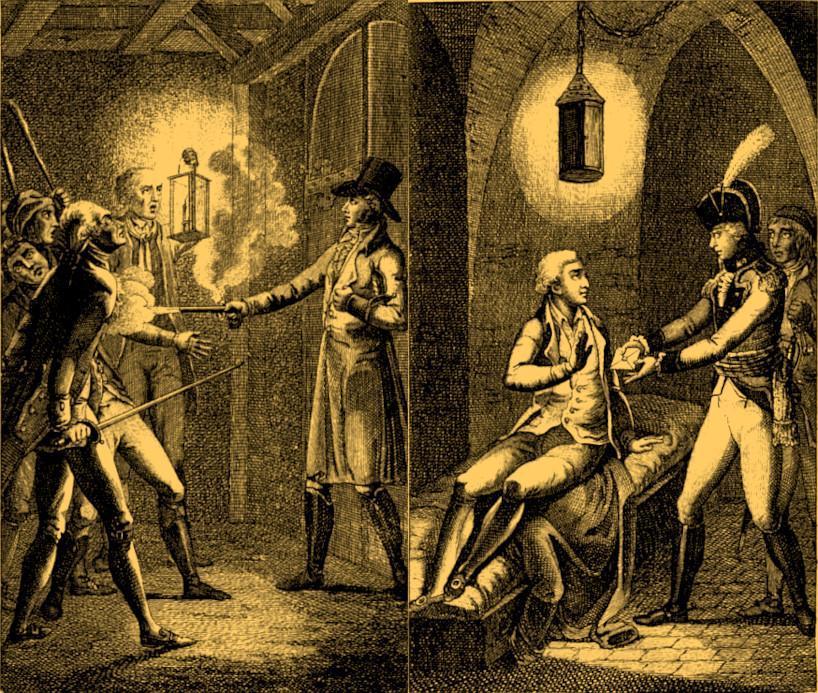
References to this novel appear later in Caroline’s correspondence. See the synopsis in Wolfgang Menzel, Deutsche Dichtung von der ältesten bis auf die neueste Zeit, 3 vols. (Stuttgart 1859), 3:240:
Shortly before the Seven Years War, Count Donamar becomes a Prussian cavalry officer. En route he comes across a toppled carriage and encounters a French woman of sublime beauty. Shortly thereafter, in his camp, he meets a mysterious, handsome, masculine Prussia hussar officer, San Giuliano, with whom he fights but then reconciles. Indeed, these kindred souls become best of friends.
Dispatched by the king to Berlin, he is ensnared there by the charming widow Laurette von Wallenstädt. Completely seduced by her, he discovers that she also loves others, so he flees. He encounters the French beauty once more on the journey. —
In volume 2, San Giuliano relates his own story to Count Donamar. He was born in Spain, spent time as a prisoner and slave in Tunis, returned, abducted a nun and was caught by the inquisition, from whose dungeons he barely managed to escape.
At a magnificent Berlin social gathering, Donamar encounters the beautiful French traveler with the beautiful eyes again, a certain Mademoiselle d’Aubecourt, in whom, however, he soon recognizes a long lost playmate and sweetheart from his childhood, Francisca von Sternach. Her companion, Marquis von Cressy, to whom she is bound by an oath, lures Donamar into an ambush, though Donamar fells him with a sword and escapes all his companions, but must then flee the authorities.
The Marquis, after a time of reflection, gives Francisca a small box with jewels he has hidden and sets her free. The reader then suddenly learns that Francisca is the same nun Gabriele whom San Giuliano once loved and whom the clever marquis stole from him through deception, who, however, desired only Francisca’s protection, not her love. Francisca declares to Donamar that she can never become his beloved, since she cannot be unfaithful to her Pedro (San Giuliano), even though she thinks he is dead. —
In volume 3, Donamar arrives at a small court where Laurette, who still loves him, sets traps for him out of jealousy and vengeance and entangles him in a trial for high treason. When his execution becomes inevitable, she intends at least to spare his a public death and gives him [and herself] poison. Francisca appears once more at his death bed, sees San Giuliano, who has just arrived [stabs himself], and dies of emotional grief. She is buried with Donamar.
In his autobiographical essay, “Der Verfasser: eine litterarische Biographie,” Kleine Schriften, vol. 1 (Göttingen 1818), here 39–40, Bouterwek himself assesses the novel in hindsight:
The years the author recalls with least pleasure include the initial ones during his second stay in Göttingen, when his literary folly reached its pinnacle. In Graf Donamar, which was published at the time, the author’s errant imagination concentrated into a single focal point all the extravaganz and false ideality that was currently afflicting his entire being. If the German reading public had simply forgiven the twenty-four-year-old author the ostentatious distortions of life with which the novel is replete, such would have been fair enough.
What happened instead, however, is that not only did the book enjoy such enormous success among the public — one that prefers to read nothing but novels — that it was quickly reprinted and even translated into several other languages, it was also given at least one public review characterized by truly rare enthusiasm.
The wholly justified condemnation that was finally passed on Donamar in the Jena Allgemeine Literatur-Zeitung, probably by Huber, was all the less capable of opening the author’s eyes because, like many other, similar reviews, it was composed much in the style of an oracle, its harsh reproach simply stated, but without proof.
Fortunately, however, the author’s clearly overheated imagination had largely spent itself in this novel, and when the third volume was finally published, even he himself had lost faith in its overall merit.
Concerning Huber’s review and Caroline’s mistaken initial notion that Friedrich Ludwig Wilhelm Meyer was its author, see Caroline to Meyer on 22 September 1792 (letter 115). Back.
[44] Friedrich Bouterwek, Gedichte (Göttingen 1802), 53 (here the title page and frontispiece to the volume; Mnemosynae, Latin: “to the goddess of remembrance”; illustration of the Weende Paper Mill ca. 1810: anonymous colorized engraving):


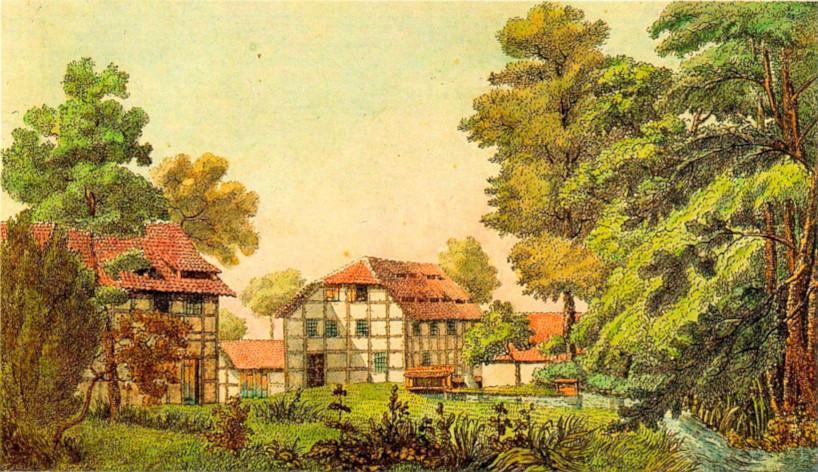
The Mill Wood
Do take me up with all my dreams,
Thou intimate, beloved, half-dim green!
For here do fantasies of recollection swing
Round about the spring, whispering with the trees.

To the mill wheel's gurgling am I drawn,
Follow the waves, watch them flee
Behold the shore's luxurious green,
For me life's blossom does blossom anew.

And yet, kind wood, intimate friend that you be,
May your quiet treetops always quiet remain!
And hope alone from their branches to me descend!

Then to my weak heart — that too easily forgets
How impetuous fervor its evil demon begets —
May the angel of peace then beneficently descend.
Bouterwek was indeed enchanted with Luise and would court both her and Lotte that autumn, as attested by Friedrich Schlegel in a letter to Wilhelm Schlegel on 8 November 1791 (Walzel, 23; KFSA 23:29): “Bouterwek has been seriously courting the Mademoiselles Michaelis, who have been out a great deal in society since their father’s death [on 22 August 1791].” Back.
[45] Pyrmont, town in Lower Saxony on the River Emmer; a popular spa resort that gained its reputation as a fashionable place for princely vacations in the seventeenth and eighteenth centuries. It did not receive the name “Bad” Pyrmont until 1914, whence the reference here and in Caroline’s letters to “Pyrmont” instead. Back.
[46] The sonnet manuscripts were not included in the materials Julius Steinberger had at his disposal (Erinnerungen, 132). The eight sonnets, however, were published in the Göttingen Musenalmanach 1793, the sonnet cited earlier, “Das Mühlenwäldchen” appearing on p. 207. Back.
[47] See Caroline to Friedrich Ludwig Wilhelm Meyer on 29 July 1792 (letter 113): “I rescued Louise from him after discovering he was trying to engineer some game or other with her — his letters sounded like something from a bad novel by a student.” Back.
[48] Not included in Bouterwek’s Gedichte (Göttingen 1802). Back.
[49] Unclear reference to “the Siebolds.” Although Julius Steinberger, Erinnerungen, 132, refers to Adam Elias von Siebold, who was studying medicine in Göttingen at the time, he was but ca. seventeen years old at the time (born 1775), and likely not married. Back.
[50] Wilhelm Schlegel entered the university in Göttingen in 1786, when he was nineteen years old, living in the house of Christian Gottlob Heyne. Back.
[51] Prince Augustus had been in Italy since October 1792 (with Tatter); he had spent January 1789 and February 1791 in Hyéres. Back.
[52] Julius Steinberg, Erinnerungen, 133, suggests Luise is mistaking “Büsching” with Johann Georg Büsch (1728–1800), a teacher of mathematics at the Hamburg Gymnasium, or with Paul Hinrich Büsch (1756–1837), a Hamburg physician. Back.
[53] Uncertain reference. Julius Steinberger, Erinnerungen, 133, remarks that the reference “Schwigel” likely refers to the later general Heinrich Ernst von Schwicheldt (1748–1817), though the geneaological sources, viz., Friedrich Vogell, Versuch einer Geschlechtsgeschichte des reichsgräflichen Hauses von Schwicheldt (Celle 1823) 1:303, 310, 311, here 311–12, do not include the daughter in the list of children. The reference may, however, be to his brother, General-Major Jobst Ernst von Schwicheldt, who with his brother was elevated, along with their marital issue and the as yet unmarried “Bertha Auguste von Schwicheldt,” to the status of counts in December 1790. Back.
[53a] Lotte Michaelis died as a result of complications during childbirth on 2 April 1793. Concerning the circumstances and the resulting scandal, see Georg Tatter’s letter to Luise Michaelis on 27 April 1793 with note 1. Back.
[54] Uncertain reference; perhaps a son of Johann Andreas Murray or of the latter’s brother, Göttingen Professor Johann Philipp Murray (1726–76). Back.
[54a] Presumably the poem “Der Rheinfall” by Gotthold Friedrich Stäudlin, Gedichte, 2 vols. (Stuttgart 1788) 1:78–81. Back.
[55] Just outside the earlier Peter’s Gate (Petrithor) was the suburb Rennelsberg, which included the Convent of the Cross as well as (in 1789) thirty-two houses (Philipp Christian Ribbentrop, Beschreibung der Strassen, einiger öffentlichen Gebäude und der Kirchen der Stadt Braunschweig (Braunschweig 1789) 96–97. Back.
[56] The former Kreuzkloster in Braunschweig, founded in the early thirteenth century and also known as the Convent St. Crucis, was located outside the Peter’s Gate. From 1400 it was used as a Cistercian convent, and after initial resistance following the Reformation became Lutheran convent. It was destroyed by allied bombing on 15 October 1944.
Philippine Charlotte Jerusalem was its abbess 1789–1823, that is, during the period when Luise and Caroline were living together in Braunschweig. Here on a town map from the year 1400 with the suburb Rennelsberg mentioned above, the Schweinemarkt (where Luise and her husband lived), and the Peter’s Gate (Braunschweig: Plan der Stadt um das Jahr 1400, Urkundenbuch der Stadt Braunschweig, ed. Ludwig Hänselmann and Heinrich Mack, part 1 [Berlin 1905], 1321–1340), and on postcards from (1) 1902 and (2) undated:
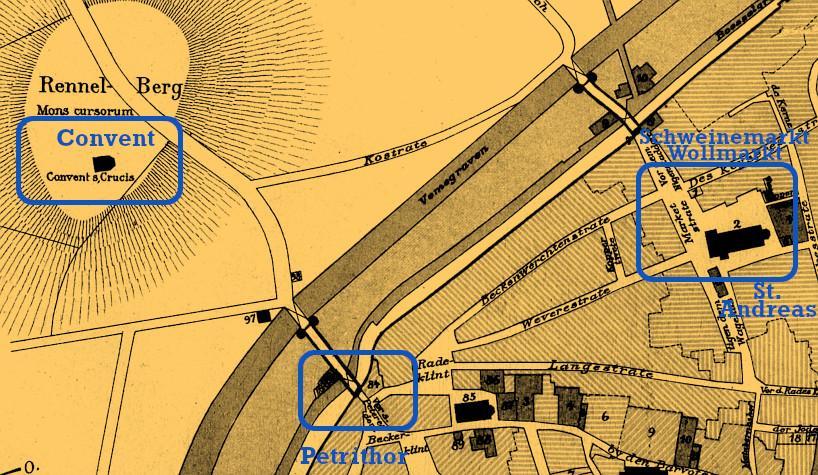
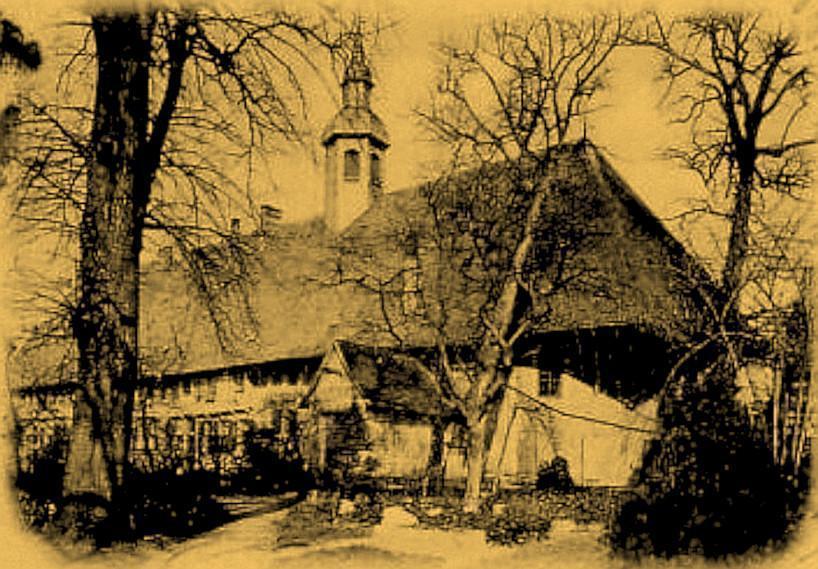
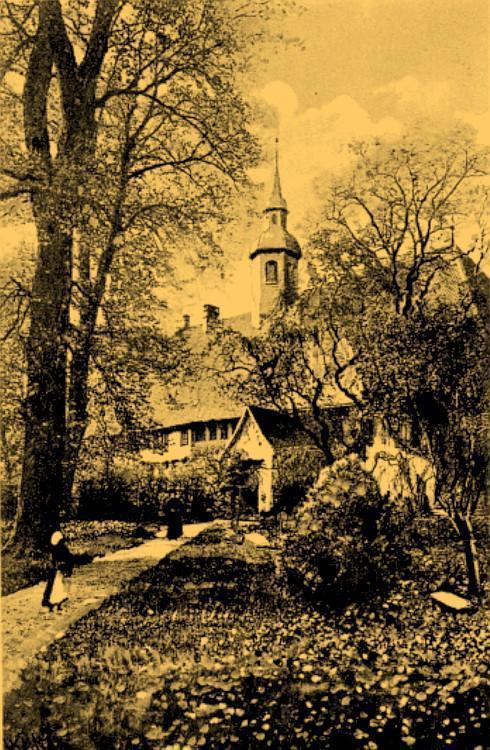
[57] According to Julius Steinberger, Erinnerungen, 134–35, a Göttingen residents index lists two brothers von Knorring from Estonia, Johann Gotthard and Gustav, living with the Dieterichs from May 1794 till autumn 1796. The younger had problems with the university in 1796 and was threatened with expulsion for otherwise unspecified youthful transgressions; Georg Christoph Lichtenberg and Abraham Kästner both spoke on his behalf (Lichtenberg, Briefe, 3:173, 319f.) and in favor of an amelioration of the punishment. The relationship between these two von Knorrings and Karl Gregor von Knorring (1769–1837), second husband of Sophie Bernhardi, is uncertain; Josef Körner, Krisenjahre, 3:index s.v. Knorring, indexes two brothers: Ludwig Johann von Knorring and Gotthard von Knorring, and a paternal uncle, Gotthard Johann (Bogdan Fedorovich) von Knorring, the latter the brother of Karl Gregor von Knorring’s father. Back.
[58] See Caroline’s letter to Johann Diederich Gries on 9 June 1799 (letter 240), note 16. Back.
[59] Dowager Duchess Anna Amalia’s mother died in 1801. Back.
[60] “Sophie Tischbein visited the Schlegel family in Jena from August till 20 [correct: 14 or 15] September 1799 — Tischbein had gone to Karlsbad — initially with her two-and-a-half-year-old son, Karl; at first, her daughters [Caroline and Betty] only came over to Jena now and then from Weimar [where the family had been staying]. When Caroline’s five relatives from Braunschweig departed [Luise and her family members] — before whom Ludwig Tieck and Friedrich von Hardenberg had also been visiting — the two Tischbein girls could come over to Jena permanently as well. . . . Sophie Tischbein then took Auguste back with them to Dessau for eight weeks, Auguste going for reasons of both friendship and her love of music, remaining then until 26 November 1799 and training her very pretty and already partially developed voice even further, and also engaging in a great many other (in her mother’s [Caroline’s] opinion: too many) entertaining distractions. Her [step-] father [Wilhelm Schlegel] picked her up and brought her back to Jena” (Adolf Stoll, Der Maler Joh. Friedrich August Tischbein und seine Familie: Ein Lebensbild nach den Aufzeichnungen seiner Tochter Caroline (Stuttgart 1923) 103. Back.
[61] Wilhelm Schlegel’s cycle Todtenopfer, in Musen-Almanach für das Jahr 1802, 171–86; also Sämmtliche Werke 1:127–40. Back.
[62] After Auguste’s death in July 1800, both Wilhelm and Caroline remained in Bamberg until October 1800, traveling thence to Braunschweig together; Wilhelm then departed Braunschweig for Berlin on 21 February 1801, while Caroline (with Luise and Emma) returned to Jena in April. Wilhelm returned briefly to Jena in August, then left permanently in November 1801, returning to Berlin. Back.
[63] Philipp Michaelis had since established himself in Harburg. Back.
[64] Christoph Martin Wieland lived on the estate Ossmannstedt near Weimar from 1797 till 1803 and is buried there along with his wife and Sophie von La Roche’s granddaughter, Sophie Brentano, who died there in 1800 during a visit. Back.
[65] Wilhelm Schlegel, “Das Feenkind. An Friederike Unzelmann,” a lengthy homage in light stanzas, Musen-Almanach für das Jahr 1802, ed. Wilhelm Schlegel and Ludwig Tieck (Tübingen 1802) 101–6 (also Sämmtliche Werke 1:235–39). Wilhelm composed several poems in her honor. For the text to this and other poems, see Wilhelm Schlegel’s poems to Friederike Unzelmann-Bethmann. Back.
[66] Friederike Unzelmann arrived in Weimar on 19 September 1801 for eight successive guest performances beginning on 21 September; she departed on 2 October. Back.
[67] Christoph Martin Wieland, “An Psyche,” Der Teutsche Merkur (1776) no. 1:12–18, here 15:
A handsome sorcerer it was,
With his pair of dark and darker eyes,
Bewitching eyes, with divine looks replete,
Equal to the task of killing ‐ or delighting. Back.
[68] On 22 September 1801, Goethe notes in his diary: “Evening: grand tea for Madam Unzelmann” (Weimarer Ausgabe III:3:35), and on 20 October: “Evening: at J[ustiz]R[ath] Hufeland, who gave a farewell dinner for the Wiedemanns” (ibid., 39). Back.
[68a] Concerning Friedrich Ludwig Wilhelm Meyer’s “zebra coat” back in 1785 and the considerations prompting Luise’s indignation in seeing such fashion on a consistory councilor, see the witty poem in Lotte Michaelis’s letter to Caroline in November 1785 (letter 64), also with note 15. Back.
[69] Same as note 28 above: Apparently an older sister of Sylvie von Ziegesar (who was not born until 1785), whose father was at that time vice president of the High Consistory in Gotha. Back.
[69a] See Luise’s recollections with those of Friedrich Jacobs, Personalien (Leipzig 1840), 264–65, who remarks on the occasion of Auguste Schlichtegroll’s death in 1832:
During this journey, from which I returned at the end of July (1832), one of my lady friends from my younger days died, namely, Auguste von Schlichtegroll, née Rousseau, at Berneck in Franconia at the home of her youngest son, whom she was visiting at the time to help set up his household. The middle of three sisters, she was characterized by a delicate stature, a graceful figure, expressive eyes, but even more by rare intellectual animation, lively wit, and a cheerful disposition. Sought after by men, and educated as she was, and finding pleasure herself in the company of men herself, she perhaps did not sufficiently avoid the appearance which sometimes caused people’s judgments of her to go astray. She was, by the way, an excellent housewife, a tender mother, and was tenderly loved by her husband as the most loyal companion, as a prudent adviser, and amid his often difficult circumstances as a gentle consoler. For me as well, she had been a dear friend for man years; and if I was healed from my sometimes habitual gloomy sentimentality just in time, it was surely the result of my having kept her company, for she opened my eyes to the more cheerful and serene regions of life. Back.
[70] What Luise never knew, of course, is that Caroline did not spend those entire (correct: not quite) two years in Gotha between leaving Königstein on 13 July 1793 and arriving in Braunschweig in mid-April 1795. Caroline did not move to Gotha until early February 1794, having spent the previous several months (since 7 August 1793) in Lucka awaiting the birth of her child. Back.
[71] This information corrects the version of their meeting provided by Luise Seidler, Erinnerungen der Malerin Louise Seidler, ed. Hermann Uhde, 2nd ed. (Berlin 1922) 68–69, according to whom Schelling had not yet met Pauline until after Caroline died, when Pauline began taking care of her mother’s correspondence; Schelling allegedly “expressed the desire finally to make the personal acquaintance of these dear women who were now so close to him emotionally. He thus suggested a rendez-vous on Bavaria’s northern boundary, a suggestion they accepted, and at his very first acquaintance with Pauline in the postal station in Lichtenfels, she made such an immediate and profound impression on him that he asked for her hand the very next day, indeed, even wishing for the wedding to take place within the week — a wish that was also fulfilled.” Back.
[72] Wiedemann translated works by, among others, Georges Cuvier, Antoine François de Fourcroy, Busick Harwood, as well as Barthélemy Faujas de Saint-Fond’s Reise durch England (Göttingen 1799). Back.
[73] In 1802 Wiedemann became professor of obstetrics at the College of Anatomy and Surgery and was appointed privy councilor at the court of the Duchy of Brunswick and Lüneburg. Back.
[74] See J. Leyser, Joachim Heinrich Campe: Ein Lebensbild aus dem Zeitalter der Aufklärung, 2. vols. (Braunschweig 1877) 1:76–81:
Around 1791, Campe bought a rather spacious garden just outside town, one that still belongs to the family and in which he found an inexhaustible source of relaxation in the various rural activities it afforded him. . . . In the spring of 1800 he began to transform part of this extremely large garden into a wooded area, and during this work decided he would one day like to find his final resting place, alongside his grateful children, beneath these trees he himself had planted. . . . And now he began planning and building the previously mentioned final, small house. The overall arrangement was to be a symbolic illustration of the course of human life. [Various landscape features and paths in which poetic verses were placed for visitors to read signifying childhood, adulthood, happiness, etc.] . . . At the end of this second path one arrived at the entrance to a rounded clearing with the vacation house mentioned earlier. . . . Within this rounded area planted round about with poplars and acacias, Campe now had a quite sizable hill laid out, planting it then with evergreens. . . . His faithful and dear life’s companion was to rest alongside him beneath this green hill; the rest of his family, whenever death should beckon, was to repose around him between the poplars and acacias.
Over the years, Campe and his son-in-law, Johann Friedrich Vieweg, sold off parts of the property to residents of Braunschweig. In 1935, however, the city of Braunschweig itself purchased the property, and during the construction of the new railway station during the 1950s the villa on the property (not Campe’s original) was torn down and the graves of Campe and his in-laws (the Viewegs) were moved to the Magnifriedhof across the street. The area was further subdivided by the Kurt-Schumacher Strasse, west of which there is now new urban development, and the remnant is now a municipal park known as Vieweg’s Garden.
Here an illustration of the garden showing the location of Campe’s grave (“Campes Grab”; Meyers Konversationslexikon, 4th ed. [Leipzig and Vienna 1885–92], s.v. Braunschweig):

Here the garden’s location in the southeastern part of the town during the late nineteenth century (Luise and Christian Rudolf Wilhelm Wiedemann lived on the opposite side of town, at the Schweinemarkt [Wollmarkt], near the Church of St. Andreas; Brockhaus Konversations-Lexikon, 14th ed. [1893–97]):

[75] Julius Steinberger, Erinnerungen, 137, notes that according to his grandson’s handwritten biography, Wiedemann inherited a certain poetic gift from his mother, even publishing a poem, “Der zärtlichen Mutter Amalie Friederike Markgräfin von Baden” with Vieweg in Braunschweig (1804), and composing a poem, “Angelica bambina” in Italian for the baptism of a friend’s daughter (in fact, Minna [Elisa] van Nuys’s granddaughter), whose name was “Angelica” (Rudolph Schleiden, Jugenderinnerungen eines Schleswig-Holsteiners, vol. 1 [Wiesbaden 1886], 99). Back.
[76] Presumably a reference to the evening dinner Caroline and Wilhelm gave on New Year’s Day 1801 in Braunschweig that Caroline mentions in letter 279:
Yesterday we did manage to do something for the new era: Herr and Madam Schlegel gave a souper of an extremely sophisticated kind, sophisticated guests, sophisticated food, sophisticated wines, sophisticated spirit and wit. First Tristan was read aloud [then a piece by Goethe] and for dessert a Hans Sachsian Shrovetide play Schlegel had composed in considerable haste but which was no worse because of that; although it tends toward the transcendent, it is quite lively and was extraordinarily well received.
The references are to Wilhelm’s Tristan-fragment (Sämmtliche Werke 1:100–26; never published otherwise) and, “Ein schön kurzweilig Fastnachtsspiel vom alten und neuen Jahrhundert. Tragiert am ersten Januarii im Jahr 1801,” published later in Musen-Almanach für das Jahr 1802, 274–93, under the pseudonym “Inhumanus” (Sämmtliche Werke 2:147–62). Back.
[77] Christian Rudolf Wilhelm Wiedemann, together with his friends Karl Himly and Theodor Georg August Roose, had recently published a book on cowpox inoculations, Über das Impfen der Kuhblattern: Für besorgte Mütter aus dem Braunschweigischen Magazin besonders abgedruckt (Bremen 1801). Back.
[78] Julius Steinberg could not find this biography in 1929, but only a handwritten biography by Wiedemann’s grandson (for the text of the latter, see supplementary appendix Christian Rudolf Wilhelm Wiedemann). Back.
[78a] Chronological difficulties arise here insofar as Caroline, in her letters to Meta Liebeskind on both 1 February and, indirectly, 7 March 1805 (letters 390, 391), seems to assume that Luise and her family are already living in Kiel by February 1805, though the resolution to the question seems to depend on exactly where Antonie Forster was residing at the time. See Caroline’s letter of 1 February 1805 (letter 390), with note 21. Back.
[78b] Johann Valentin’s wife, Margaretha, died on 26 September 1806, and his daughter Amalia shortly thereafter, on 13 May 1807. Back.
[79] Hoffmann and Campe was and is a Hamburg publishing company founded in 1781 by Benjamin Gottlob Hoffmann and from 1823 significantly expanded by Julius Campe (1792–1867), a nephew of Joachim Heinrich Campe (an older nephew had married one of Hoffmann’s daughters). Early authors included, among others, Heinrich Heine; contemporary authors include Angela Merkal and Doris Lessing. Back.
[80] Julius Steinberger, Erinnerungen, 137, suggests the reference is to what was known as the Baumhaus (lit., “treehouse”), an inn situated on the Elbe River at the entrance to Hamburg’s interior harbor. Oddly, one of the early tram stops in Kiel (one station from the end of line 1) was called “Hamburger Baum,” which is the phrase Luise Wiedemann uses here. Back.
[81] Such was an issue because, as Luise doubtless recalls but does not state, none of Frederick VI’s sons survived infancy; he was succeeded by his cousin, Christian VIII of Denmark. Back.
[82] Germ. das Nestquackelche; see Alexander Askenasy, Die Frankfurter Mundart und ihre Literatur (Frankfurt 1904) 70, where a surprising number of variations of this word are said to refer to the very smallest children. See also Hensleigh Wedgwood, John Christopher Atkinson, A Dictionary of English Etymology, 2nd ed. (London 1872) 445, “nescock,” “one that was never from home, a fondling . . . the youngest bird of a brood, youngest child in a family; Germ. quack, quackel, quackelchen, nestquäck, a young unfledged bird, fig. a child of old age. ‘Das Quakelchen seines Alters.’ From quaken, to cry.” Luise is thinking of this latter expression, “das Quakelchen seines Alters,” which occurs in Goethes Die Leiden des jungen Werthers (Leipzig 1774) book 1, letter of 1 July; see trans. The Sorrows of Werther (Boston 1895) 71, “the joy of his old age.” Back.
[83] In 1773 Catherine the Great ceded the duchy of which Kiel was part to the king of Denmark, who governed the city as Duke of Holstein. After the end of the Holy Roman Empire in 1806, Kiel and Holstein became part of Denmark proper. Then during what became known as the “Cossack Winter” of 1813, during the Napoleonic wars, Kiel was occupied by Sweden. The Peace of Kiel in 1814 ended the occupation, and though the Duchy of Holstein continued to be ruled by the Danish king, in 1815 it became a member of the German Confederation, effectively making Kiel again part of Germany. Back.
[84] Elise Schleiden (née van Nuys) recalls these readings as well, though with a less positive assessment of Wilhelm Schlegel (Rudolph Schleiden, Jugenderinnerungen eines Schleswig-Holsteiners, 1:74–75): “He speaks with incomparable ebulliance, nor is anyone capable of more beautiful declamation, and yet as receptive as his heart surely is, I nonetheless consider him to be a feelingless person who basically loves only himself.” Back.
[85] Prussia ceded the Duchy of Lauenburg, 40 km southeast of Hamburg on the Elbe, to Denmark in July 1816. Back.
[86] See the memoirs of Rudolph Schleiden (Minna van Nuys’s grandson) and of his mother, Elise Schleiden, née van Nuys (her first daughter), from this period (Rudolph Schleiden, Jugenderinnerungen eines Schleswig-Holsteiners, 1:75):
When he [Wilhelm Schlegel] left Kiel on 26 January 1814, he sent a final note of farewell with the words, “Farewell to my three beautiful, charming, amiable lady friends!” My mother’s memoirs remark in this regard: “These words were directed to my mother, whom he had long loved and whom he had once asked to marry him; Julie Hegewisch, in whom he had similarly fallen in love at the time but who had rebuffed him, having herself already fallen in love with Dahlmann, whom she later married; and me, to whom he was wont to refer as his “intimate friend.” Back.
[87] Wilhelm Schlegel had been a professor in Bonn since late 1818. In the wake of the stabbing of August von Kotzebue on 23 March 1819 by the student-order member and theology student Karl Ludwig Sand in Mannheim (prompting the Carlsbad Decrees in Frankfurt in September; Sand himself was executed in May 1820), both Karl Theodor Welcker and his elder brother Friedrich Gottlieb Welcker were suspected by the Prussian administration — who were responsible for the university in Bonn — of subversive activity and membership in proscribed organizations; see Karl Wild, Karl Theodor Welcker: ein Vorkämpfer des älteren Liberalismus (Heidelberg 1913), 69–70:
On 15 July [1819] the two Welcker brothers had been in Bonn for hardly three months when their papers were confiscated; the confiscation of the papers of Arndt took place the same day and at the same hour. According to Karl Theodor Welcker’s own account, things went as follows. A gendarme officer appeared early that morning at his apartment and, pretending to be a friend about to depart Bonn, managed to make his way all the way to Welcker’s bedroom, where he presented him with the order of the minister of police, Prince Wittgenstein. The accompanying gendarmes then searched the entire house, emptying anything containing written materials, packing it all in mortar sacks, and taking it away. The next day the police commission began reading through all the papers, albeit permitting the owners to be present. This process took about a week. Part of the confiscated papers were returned as being of no consequence, the rest sealed and sent to Berlin. The commissars, however, with but a cursory view of the materials, reported amid considerable officiousness that they had found evidence of the founding of a German Confederation and correspondence concerning the establishment of a “gonfalonier,” which strengthened the Berlin administration’s suspicion that a secret association was at work. Back.
[88] Carl Theodor Welcker, Oeffentliche actenmässige Vertheidigung gegen die öffentliche Verdächtigung der Theilnahme … an demagogischen Umtrieben in und mit Abhandlungen für das öffentliche Recht, etc. (Stuttgart 1823) Back.
[88a] Bracketed [?] by Julius Steinberger. — Perhaps Dr. U. J. H. Becker (1791–1843), conrector of the cathedral school in Ratzeburg. Back.
[89] Lavater had accompanied his son to Göttingen in June 1786, where the latter was to study medicine. Hence Luise must have seen him just as she herself arrived back in Göttingen from her schooling in Gotha, where she had been since the autumn of 1784. Back.
[90] Carl Friedrich August Grosse, Memoiren des Marquis von G***. Vom Verfasser des Genius (Berlin 1792), 185–216, concerning the family of Professor P* (Johann David Michaelis); for text see supplementary appendix 114.1. Back.
[91] Bettina von Arnim was acquainted with the eldest, Friedrich, spending considerable time with him in Munich. See Goethe’s Correspondence with a Child, trans. (Boston 1879) 204 (letter of 3 March 1809):
You perhaps know, or remember having seem a certain Count Stadion, prebendary and imperial ambassador, called by his friends “Black Fritz”; he is my only friend here: the evenings which he has unengaged he willingly spends with me: then he reads the papers, writes dispatches, listens to me when I tell some story; — we often talk, too, of you: a man of prudent, unfettered views, and of noble manners. He imparts to me remarkable passages out of the history of his heart and life; he has made many sacrifices, but has not thereby lost anything; on the contrary, his character has thus become freed from the stiffness, which always more or less takes the place of natural grace, as soon as one stands in a not unimportant connection with the world, where one must partly devote one’s self to the artificial: he is exactly as simple as a child, and in my loneliness gives many a turn to my humors. On Sundays he fetches me in his carriage, and reads mass to me in the royal chapel; the church is generally quite empty, except a few old people. The silent, lonely church is delightful to me; and that the dear friend of whom I know so much which is kept in his heart, should raise for me the host and the chalice, — that too delights me. Ah! would that I knew that in any way he were compensated for what has been taken from him. Back.
[92] This information suggests redating letter 65 (in which Caroline recounts that Luise related much to her about “a quarrel with Busch”) from early 1786 to late 1786, since Luise did not arrive back in Göttingen from Gotha until the summer of 1786. Back.
[93] From the preface to Julie or the New Heloise, trans. Philip Stewart and Jean Vaché (Hanover, NH 1997) 3–4: “Never did a chaste maiden read Novels; and I have affixed to this one a sufficiently clear title so that upon opening it anyone would know what to expect. She who, despite this title, dares to read a single page of it, is a maiden undone.” Malortie advised Luise instead to read Joachim Heinrich Campe, Väterlicher Rath für meine Tochter. Ein Gegenstück zum Theophron, der erwachsenen weiblichen Jugend gewidmet (Frankfurt, Leipzig 1789), a book, of course, with whose author Luise herself would become closely acquainted in Braunschweig, and with his daughter, Lotte Vieweg as well, to whom the book was dedicated. Back.
[94] Caroline confirms this opinion in letter 2, and Lotte Michaelis in letter 64. Back.
[95] See esp. letter 64. Back.
[96] See Pütter, Gelehrten-Geschichte 2:407: “That evening [Tuesday, 18 September 1787], there was a ball in the town hall, to which any students wishing to participate were admitted and 520 tickets distributed by the royal marshal. Dinner was served in the mercantile building in two different halls. To ensure that the path leading to the building remained dry, a wooden plankway was laid, over which a linen roof was held in place by poles and illuminated by torches.” Back.
[97] Julius Steinberger, Erinnerungen, 141, reports that the ball in 1787 was as a matter of fact severely disrupted by drunken students. Back.
[98] See Caroline’s letter to Julie von Studnitz on 26–29 October 1781 (letter 26). Back.
Translation © 2012 Doug Stott